A conversation with PETER MARTENSEN

On uniforms, judgment, and nature — how one ordinary man becomes a question about all of us
Who is the man beneath the uniform? Is a good man simply one who has never been tested? And when a man is deemed honourable, who decides?
These are questions that Peter Martensen’s body of work asks of us, but never once does he resolve these poignant and desperate pleas, not through his paintings, nor through his words. After a year of searching through his work and our conversations, like digging for bedrock in sand, my longing for solid ground brought, in equal measure, a deeper urgency and a disquiet that only grew louder.
Every man believes he will act honourably when the moment comes, but the moment rarely announces itself. Sometimes it arrives in an instant, and a man discovers, too late, which way his feet will carry him. Sometimes it arrives disguised as routine, step by step, one small compliance at a time, until an ordinary man no longer recognises what he has become.
Whether a man can be deemed 'good' may be unanswerable, yet the very act of asking reveals a naive longing we have never outgrown. We still search for the elder, the just man, someone wise enough to lead and good enough to follow.
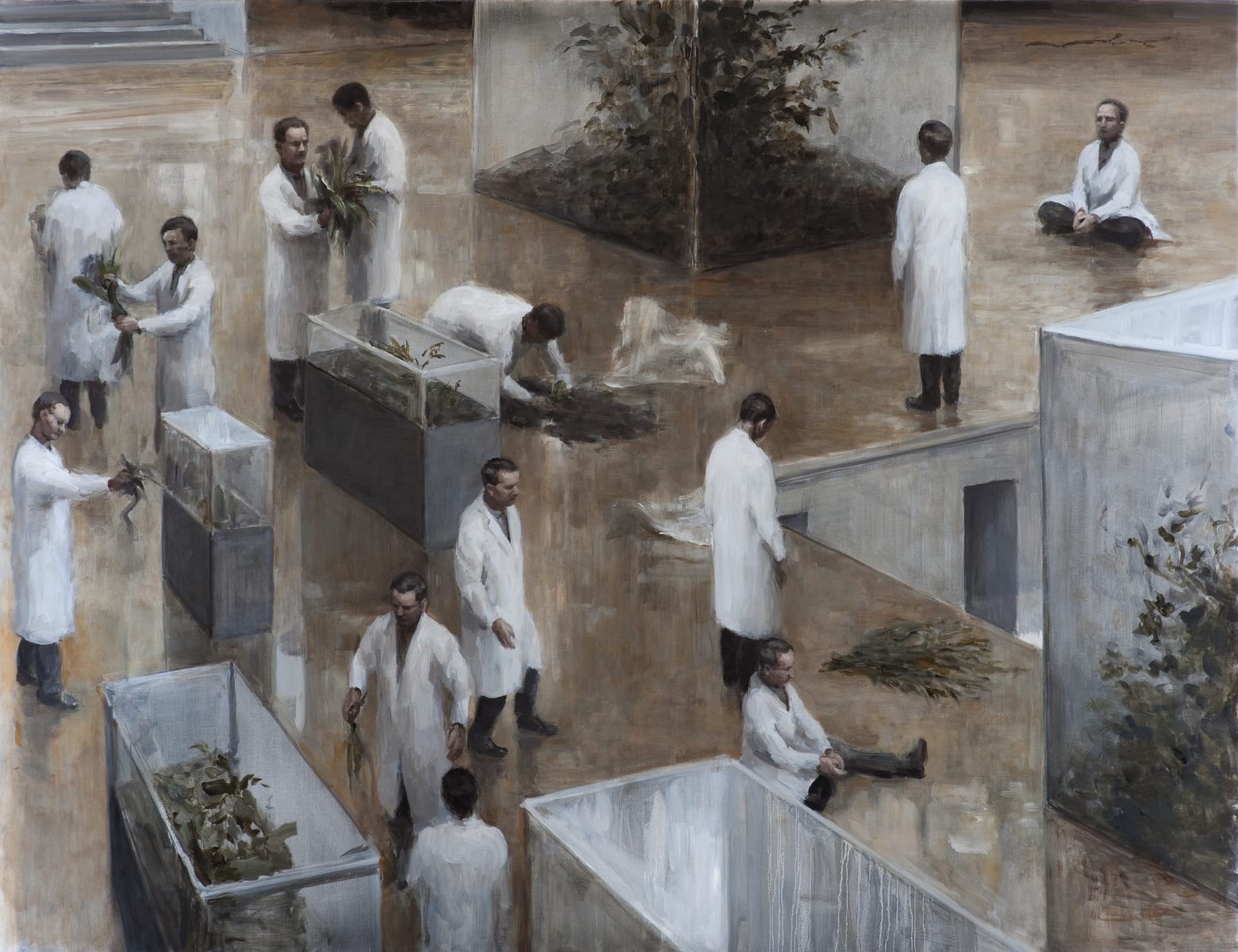
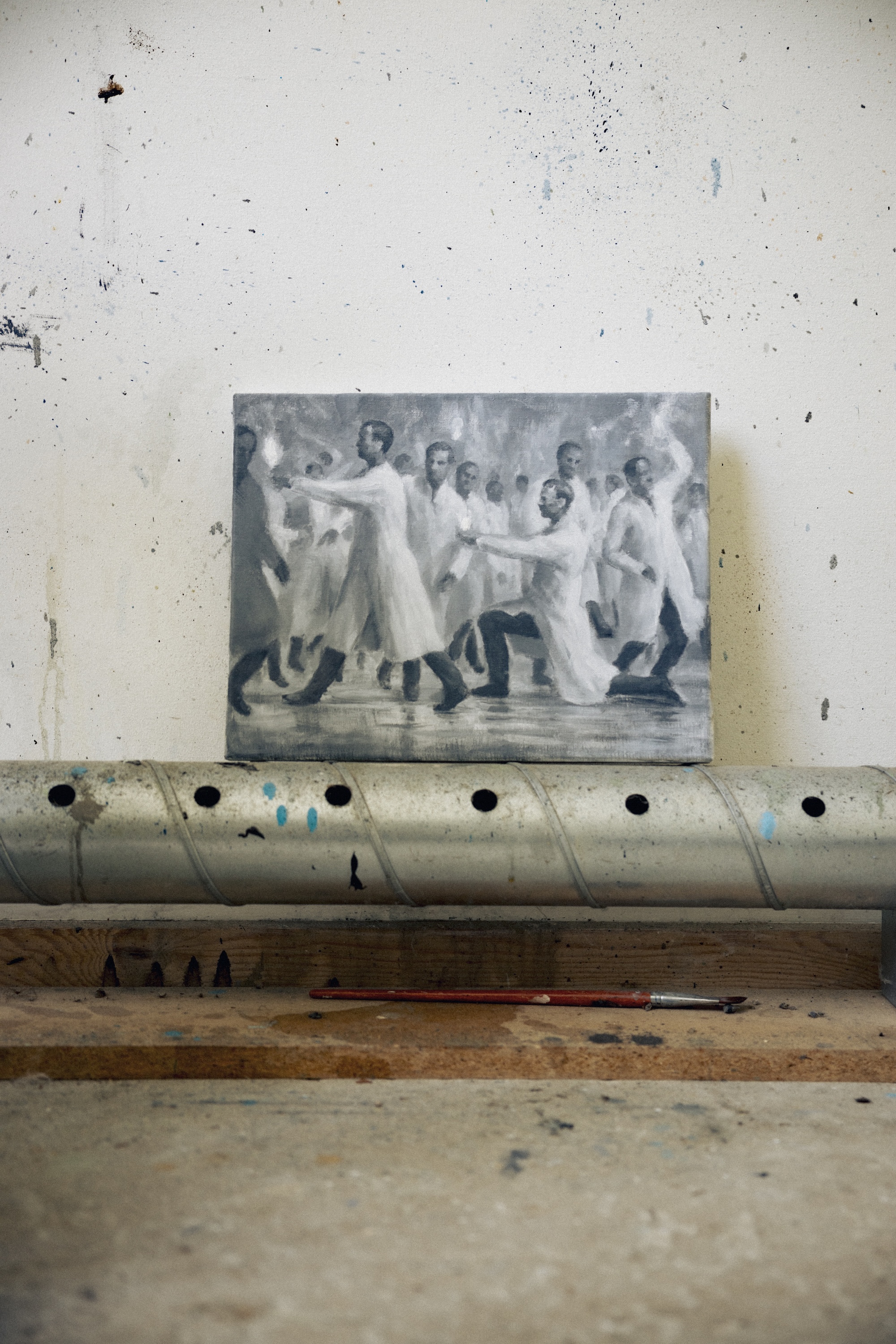
The first painting from Peter Martensen that grabbed my attention was Museum (2011). Thirteen figures in long white lab coats move through its halls, seemingly in a moment of scientific failure. Plants are the focus of their research, some held captive in glass boxes on pedestals, others, far larger, sealed in vast glass cases, once rare and precious like objects of artistic desire, now grey, lifeless, lost. Some of the men examine leaves, still in hope, others bow their heads or sit with legs splayed in surrender, one sits cross-legged, almost meditating. The same man, thirteen times over, each meeting the findings differently, but none looks surprised, and in that acceptance he seems to have returned to a part of his humanity. Near the middle a white flag in motion seems to signal a truce.
In the wild, plants need nothing from us. They have no morals to uphold, no reputation to repair, free from the societal burden of criticism, condemnation and consequence. As long as the roots hold, they return, season after season, a little changed, but whole again, a purity we can never mirror. A man, once fallen, must earn his way back, and does not always find it. Museum, seen first in mid 2020, in the thick of the Covid-19 pandemic, felt like a warning made almost a decade before its time. Nature goes on, in chorus, after every catastrophe, with or without us. Neither individually nor collectively can we say the same.
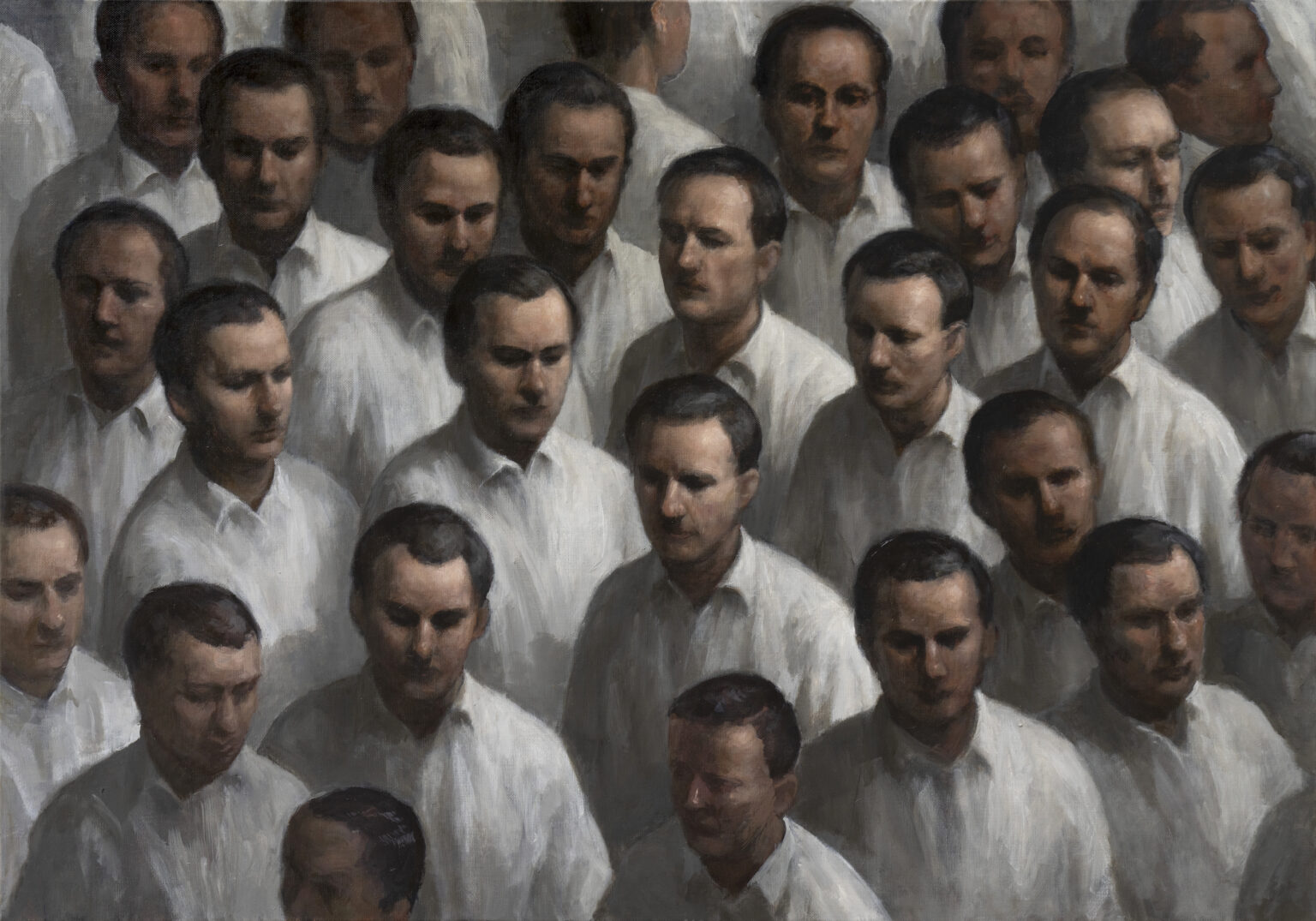
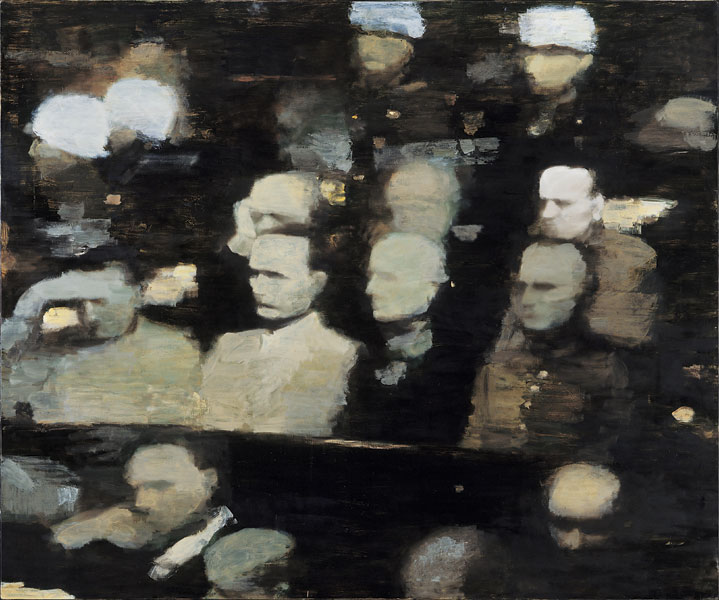
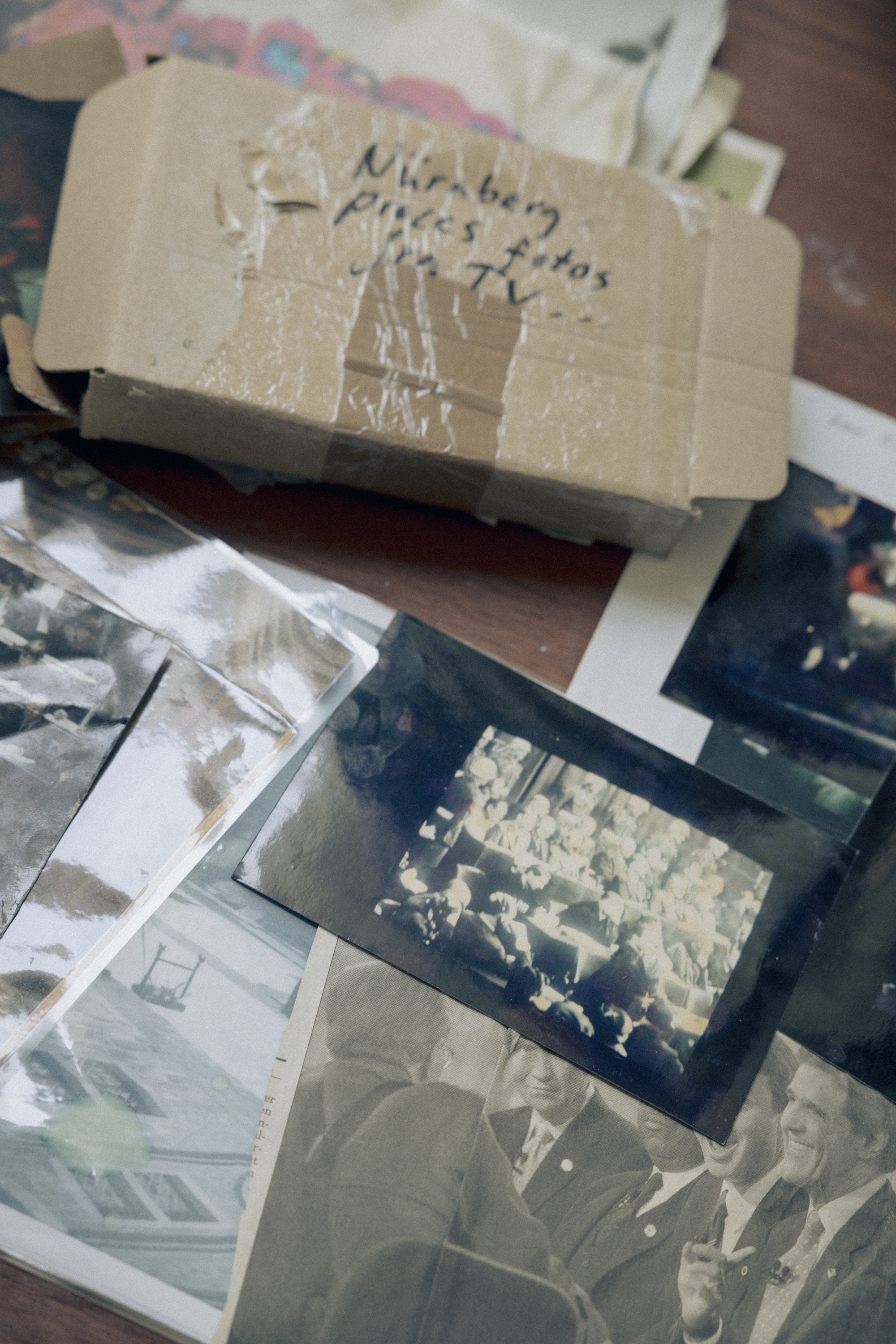
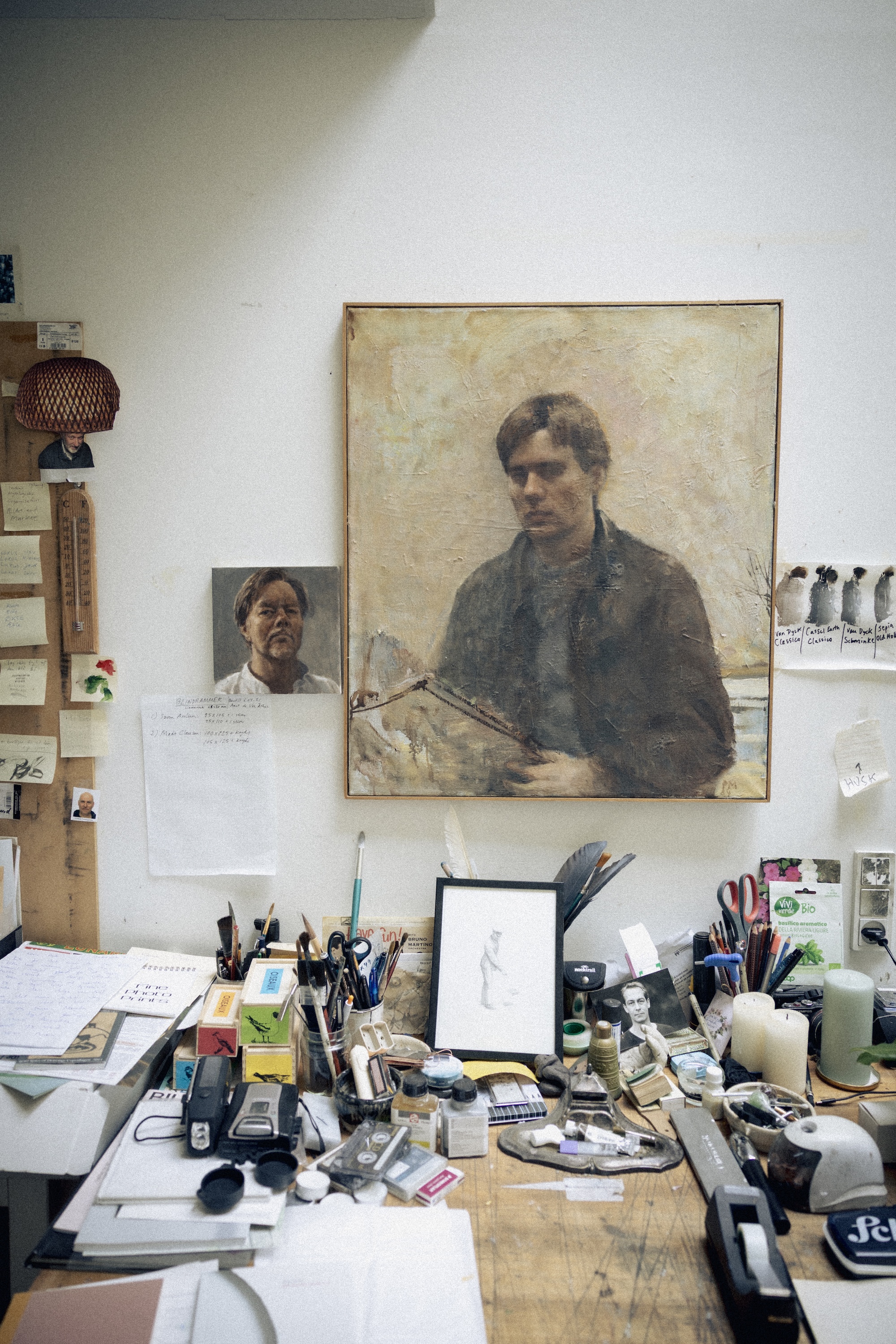
If Museum (2011) shows us what we can never be, Elegy (1995) shows us what we must never become. It draws on the Nuremberg Trials, where the surviving leaders of Nazi Germany were tried for their crimes, among them the murder of six million Jews. The trials took place seven years before Martensen was born, and he first encountered them as a boy through re-airings on television, photographing the screen. Their featureless, identical men haunt his work, which returns to the trials again and again, as it does to the world of advertising, in which his father worked. Whatever the theme, the same man returns, suited up or in a white lab coat. Who this man is isn’t clear, though Martensen wonders aloud whether his father’s presence lingers in these images. Whether a scientist, an official, a defendant or a father, it is always a man. Martensen’s world is populated by the men who run things, and it is these men his work asks us to look at.
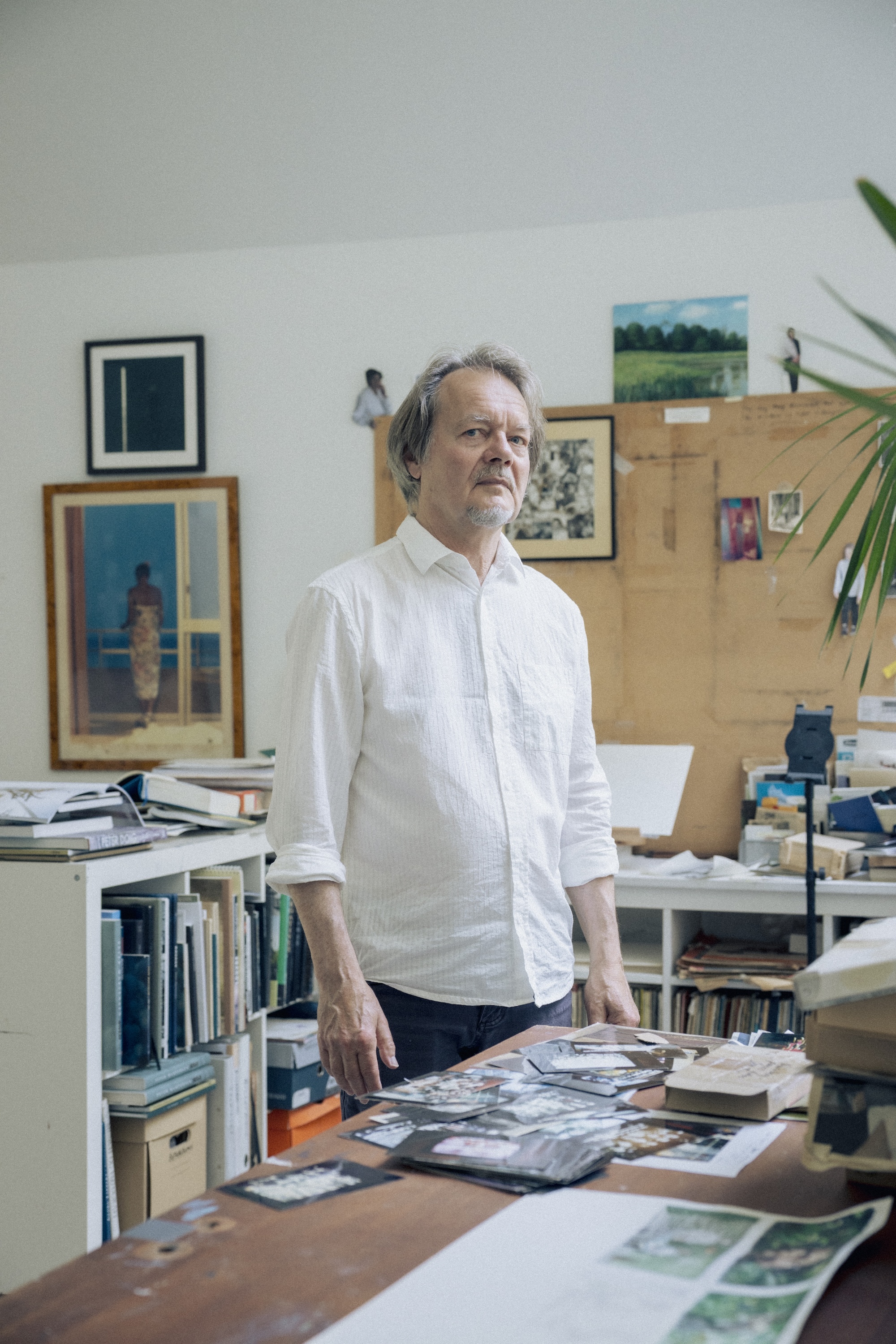
Born in Odense, Denmark in 1953, Martensen describes his parents as “quite open minded” people. His mother trained at the School of Crafts in Copenhagen, designing clothes. Of his father’s world, he recalls, “The environment around me and the people I met as a child, I’ve seen again in the TV series Mad Men. These are the kind of people I grew up among. Curious to the outside world, yet dutiful in their roles. Ad men are artistic in these ‘little smart ways’, always trying to find slogans, and sometimes I would brainstorm with my father about certain products, and how you could sell it.”
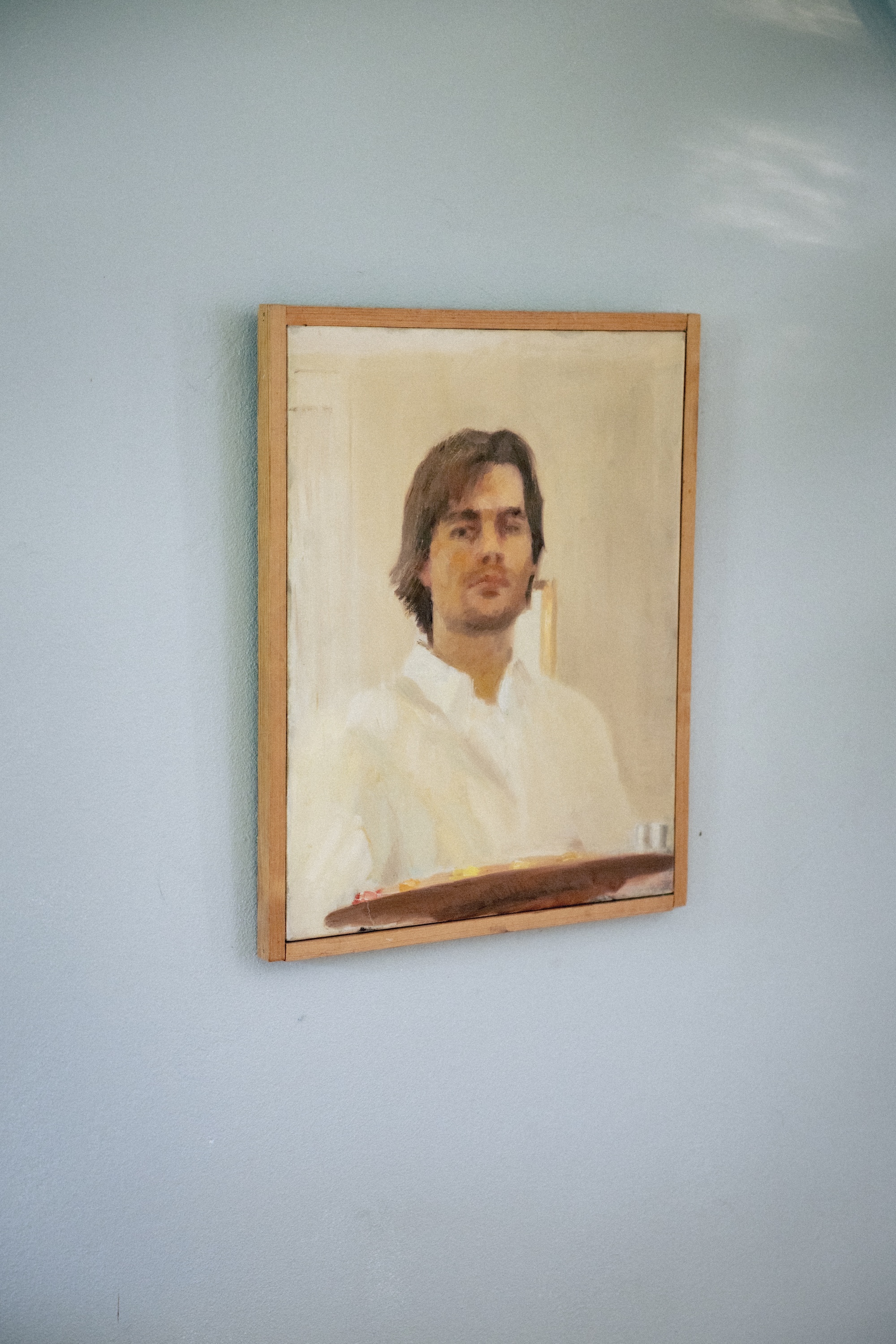
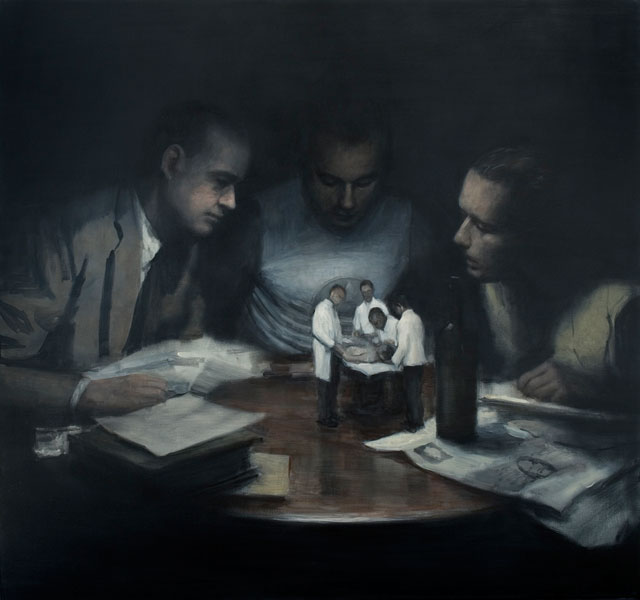
As a boy, Martensen saw in his father a “childish idea of what a man should look like,” and the figure that formed in his mind, he says, was “a sort of average looking man from the 50s, 60s.” “When I began painting,” he continues, “I took this figure into my work, and it was very easy in a way because this man I chose was uniformed, so I could use this form over and over, and not have to worry about making different styles of clothes. Most of the time, it’s a white shirt, black trousers and the same hair.”
To Martensen, the uniform carries a meaning of its own. “The men in white shirts, to me, represent among other things democracy, a ‘democratic man,’” he says. “And scientists represent a free-thinking man.” The same anonymous figure can stand for the citizen and for the accused, which is exactly what makes him so unsettling.
“When I started my career, it was not appropriate to use psychology in painting, especially not in Denmark.”
The uniform served another purpose too. Painting in Denmark was expected to be about surface, colour, line, and composition, and if you wanted to express something psychological visually, then that was the stuff of illustration… “So I used this sort of generalised figure that everybody could relate to without putting any feelings into it.”
Yet a human figure, however neutral, invites us to feel something, and repetition can heighten that rather than erase it. “It’s true,” Martensen concedes. “When I began painting these men, I saw people get a lot of emotions out of them without me putting anything to it… I didn’t have to put everything into my paintings. I could just paint.” He has a name for it now, mental realism, painting that “appears realistic at first glance, but is actually about something mental.”
He insists, too, that his work carries no messages. “I paint before I think and plan,” he told The Montreal Review in 2023, though he admits his politics sometimes slip through. “But I try to keep the atmosphere of my paintings very calm, and contained… yes… contained.”
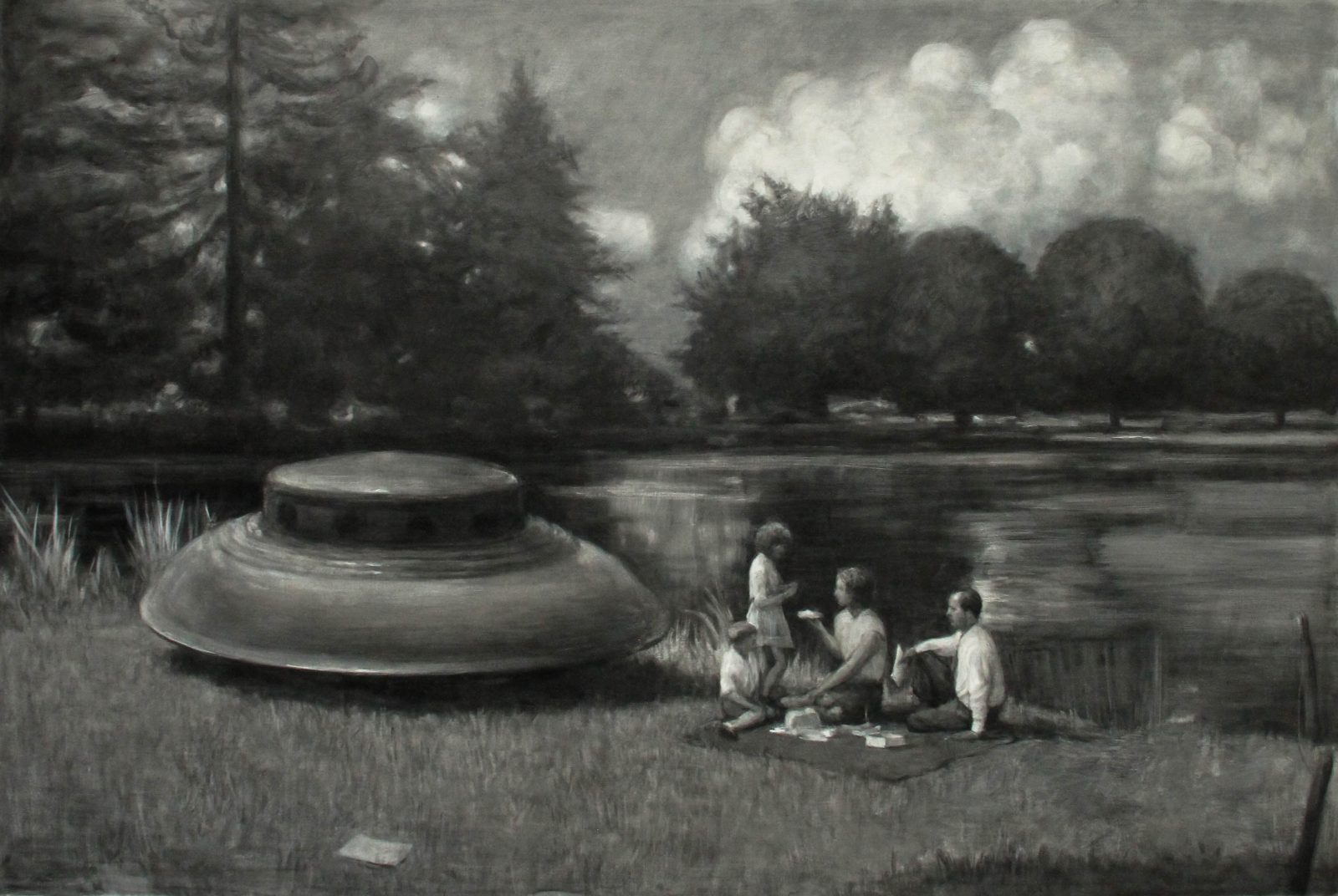
Martensen also insists there is humour in his work, which you can clearly see in Picnic II (2012). Painted entirely in greys, it looks like an old family snapshot. A family of four, two parents and two children, picnic on the grass beside a lake, beneath tall trees and billowing clouds, the girl in a short summer dress, the mother handing her a piece of cake on a plate, the son and father sitting nearby. A matter of feet away, a flying saucer straight out of 1950s science fiction has landed and sits there, unattended, as common and unnoticed as a parked car. Are they ignoring it, familiar with it, or did they arrive in it?
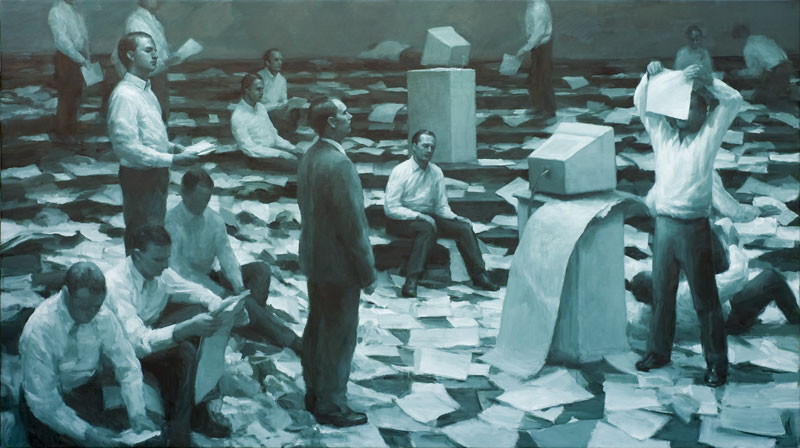
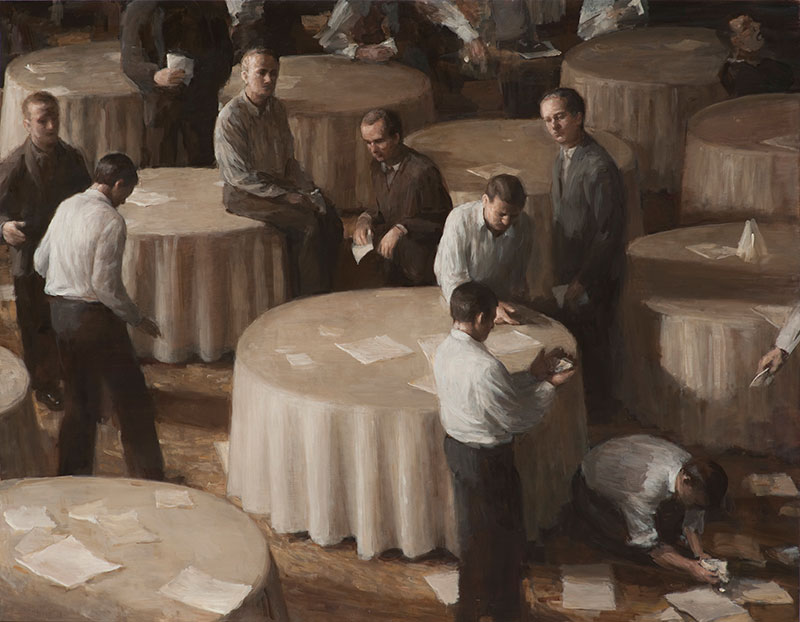
The Consequence 2 (2008), seemingly a depiction of the financial crash, is harder to find funny. Yet there is a lunacy here that cannot be denied. Its men are not every man in a suit, of course, but the ones at the very top, the ones in control, among the few the Occupy protesters would soon call the 1%, who dressed for work each day and performed honourability while gambling with the livelihoods and futures of millions, all for more dominance, more power, more money. Martensen has painted their fallen kingdom. Like a collapsed house of cards, papers and documents once deemed important blow across the floor, useless as tumbleweeds, through a corporate desert that was once relevant and respected. Nearby, computers stand on pedestals, untouched, as if they alone have kept their value, suggesting an ominous future in which machines are what we'll look to, our future kings, our future “men.”
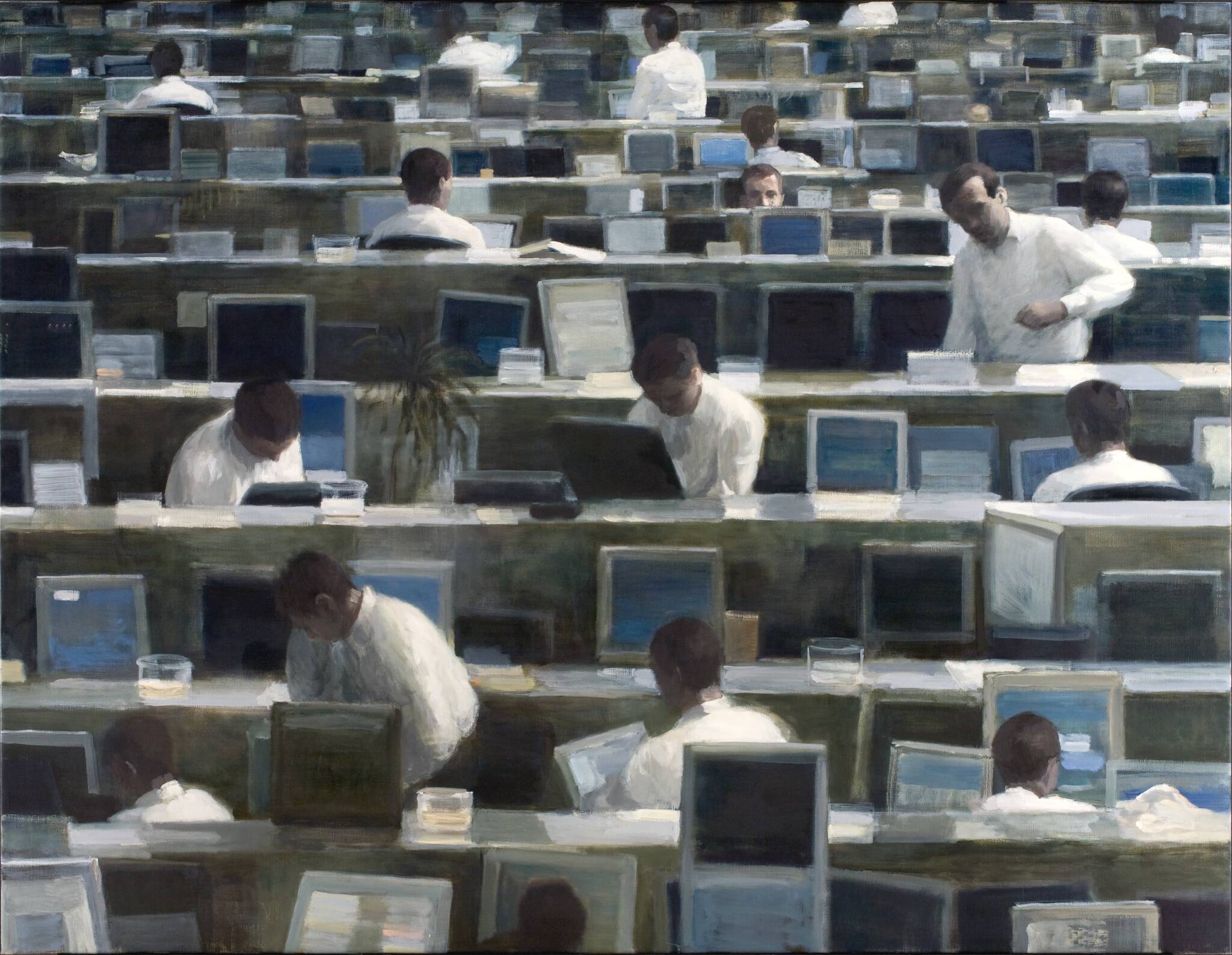
A year earlier, in Screenscape (2007), the machines were already at the centre of things. Rows of desks rise like terraces, crowded with monitors, and the men in white shirts bend toward their screens, heads lowered, as if in prayer. Only one, half hidden behind a monitor near the centre, looks up and meets our gaze.
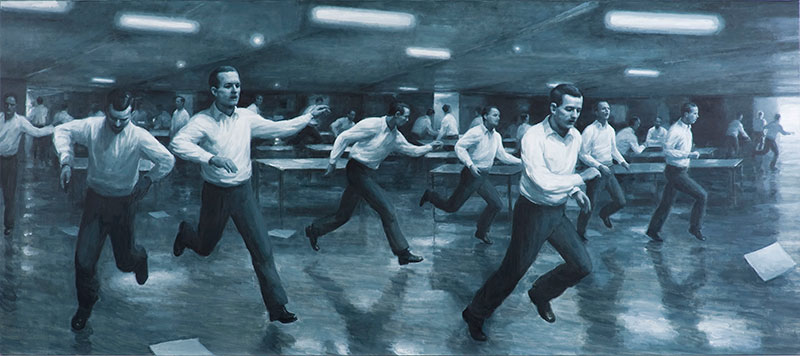
Across most of Peter Martensen’s work, this uniformed man, stripped of individual features or feeling, is rarely alone. In The Action (2009), there are nearly thirty versions of this man, running in various directions, some with their mouths open as if panting, through what looks to be a vast, empty office building. Desks remain, but there are no chairs in sight. It is no longer a place that offers stillness. As any ad man knows, repetition is how an idea builds momentum. Repeated by enough men, even the worst idea can start to feel like common sense. Safety is not always in numbers.
For Martensen, the Nuremberg paintings were a kind of sorgarbejde, the Danish word for grief work. “I was sort of working on sorrow and mourning,” he says, and the sorrow reached back to his childhood. “My mother was a terrible storyteller and loved telling these blood dripping horror stories.” When he was around five, she also told him about the concentration camps and what they did to people. “She loved horror movies,” he says. “As my father didn’t have the time, she took me and my little brother Henrik to see these horror movies, and I couldn’t sleep for years after some of these because of strange faces coming towards me when I was lying in bed.” He grew up with a very strong image of cruel men. Looking later at the men on trial, he couldn’t make them fit those stories.
“I saw all these people sitting there, all accused… And I thought, a whole country cannot be psychopaths… It must be something else. It’s like some kind of group fascination.”
Cruelty alone couldn’t explain it. To him, it was as if an entire nation had fallen under a kind of hypnosis, possessed as one until they no longer saw what they were doing. So he stripped the men of any feeling. “I just neutralised everything so there were no feelings at all, and I made them equal, as if it was the same man, Mr. Everybody who’s accused.” What he wanted to understand was not who these men were, but how such ideas had taken hold of ordinary minds in the first place.
Ben Ferencz spent a lifetime with that question. At 27, with no courtroom experience, he became chief prosecutor in the trial of the commanders of the Nazi death squads at Nuremberg. What unsettled him most was how ordinary the accused appeared. In 2017, at the age of 97, he told American journalist Lesley Stahl, “The defendants’ faces were blank. All the time. They could have looked like they were waiting for a bus.” Asked whether many of them would otherwise have been upstanding citizens, he replied, “Of course… These men would never have been murderers had it not been for the war. These were people who could quote Goethe, loved Wagner, who were polite…” Stahl pressed him. “What turns a man into a savage beast like that?” “He’s not a savage,” Ferencz replied. “He’s a patriotic human being acting in the interest of his country, in his mind… Now I will tell you something very profound that I have learned after many years. War makes murderers out of otherwise decent people. All wars, and all decent people.”
Hearing this from the man who prosecuted them, without a trace of anger in his voice, I first mistook it for a defence. It is, I now see, an unmistakable warning, from one of the last people alive who had looked these men in the eye. Those who were there cannot tell us who will turn, only how it begins.
Zoran Mušič was there too. Imprisoned in Dachau, the Slovenian painter and his fellow prisoners told one another that nothing like it could ever happen again. They would be the last. Decades later, watching the same horrors surface elsewhere in the world, he realised they were wrong, and in 1970 began a series of paintings he called Nous ne sommes pas les derniers (We Are Not the Last). Martensen’s Nuremberg paintings carry the same warning, windows to a past we should never return to, and to futures we should never inhabit.
What we put our faith in changes with each generation, a leader, a movement, a machine, but our hope stays the same, that this one will finally save us. Some of us are pushed, but many go looking, lost enough to follow anyone who promises to lead them somewhere. The same longing that sends us searching for a just man can just as easily deliver us to the wrong one.
The trials, Martensen believes, “confronted us with humanity, as it is.” Out of them came the principle that no one stands above the law, and with it the modern idea of human rights. “And now, sadly, it’s corroding.”
Martensen doesn’t recall a beginning to his painting life. “I just never stopped,” he says. “I don’t remember a time when I wasn’t drawing or painting.” After his parents died, he found bundles of loose sheets of paper stored away in their house, drawings and paintings dating back to when he was two years old. “They always told me how skillful I was… It was always available for me.”
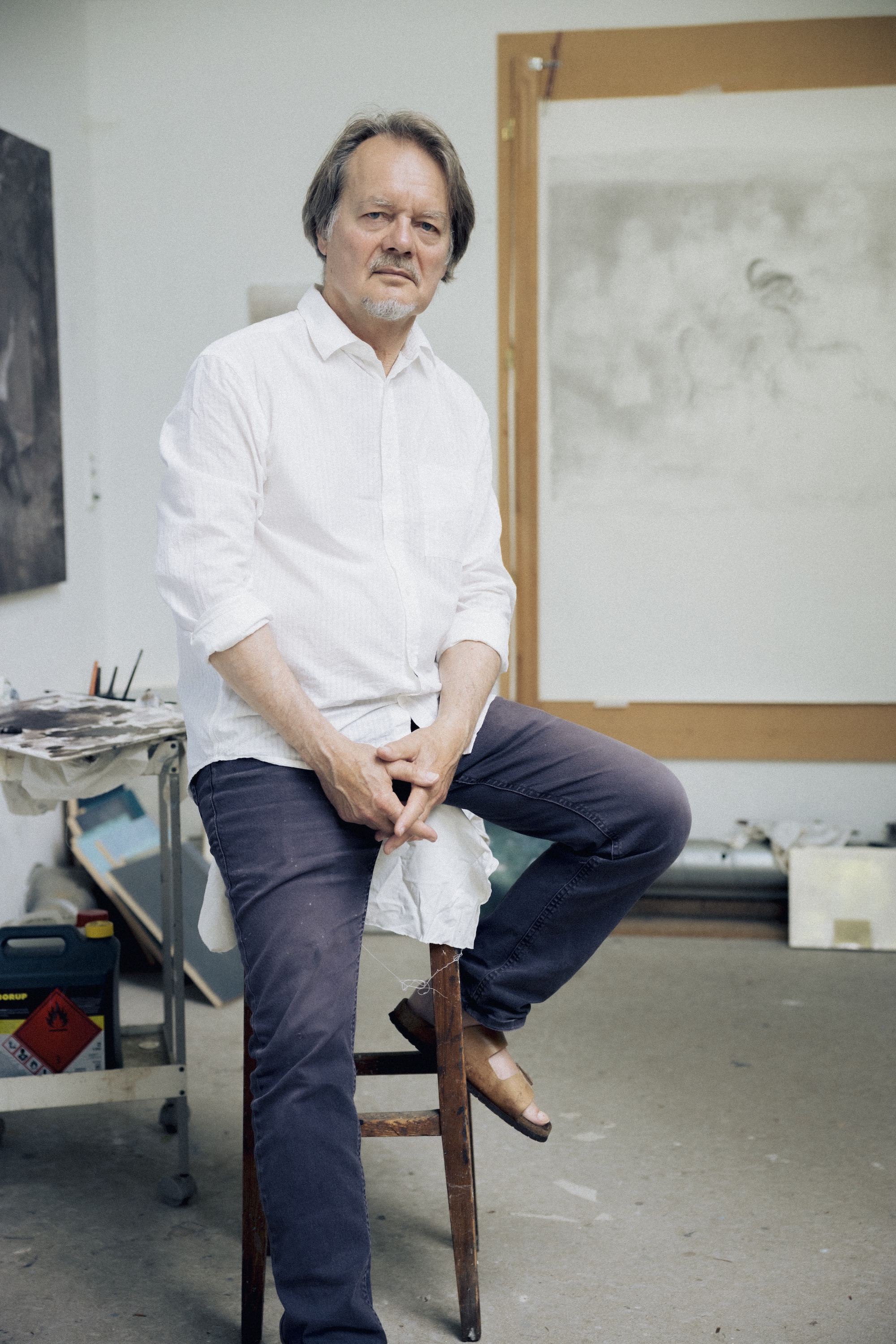
His parents gave him the two things that would shape his life, drawing and nature. “My father was a very kind and lovable person,” Peter later wrote, when I asked about him. “He was also hard working, so I remember my brother and I missed him a lot in our childhood. But when he took the time and played with us, I was in heaven. He introduced us to nature by waking us very early in the mornings in the summer house, and took us out in the woods, looking for deer, birds and frogs. He also introduced us to drawing, as did our mother. She painted still lifes in the kitchen, so there was more odour of oil paint than of cooking.”
“Suddenly, in just one year, I developed so quickly, and it just came from inside, it was not something coming from outside.”
In his teens, the ability arrived almost overnight. In his high school art class, while his friends did their homework under the table, he was the only one following the lesson. The teacher saw his drawings and told him he had to go to the Art Academy. A week later, in the middle of the school year, Martensen went to the head of the school and told him, “I will stop now.”
Having taken his leap of faith, Martensen sent his work to the Royal Danish Academy of Fine Arts in Copenhagen. The Academy said no. “I was falling into the deepest hole.” He scraped rust in a shipyard to pay for an art school on Funen, the island where he had grown up, and when his teacher there judged him not ready for the painting classes, he simply enrolled himself. For six years he was taught colourist painting in the spirit of Matisse. “I loved Matisse, but I couldn’t paint like that myself.” While his teacher arranged bright still lifes of cans and cloth, Martensen’s own canvas came out grey, black and white. Even then, he could only paint as himself.
By any measure, it was a test, though he “never once doubted, not for one single moment” that he should be a painter. “Painting, I couldn’t live without doing it.” In 1982, more than a decade after they’d turned him away, the Academy let him in. When he finished in 1984, he took a silent studio in Copenhagen looking down into the Royal Garden, “just the best place in the world,” and stayed there for six years. For now, nature was something he watched from a window.
“I’m really a great lover of nature. I’ve been that way since I was a child, but I’ve been living in cities all the time.”
Life moved quickly after that. Two daughters arrived, Ida in 1993 and Anna in 1995, and his uniformed men travelled to Paris, New York, Italy and Korea. Nature, though, stayed out of reach. “I’m really a great lover of nature. I’ve been that way since I was a child, but I’ve been living in cities all the time,” he says. That distance, he believes, runs through his work. “Most of it is about me being separated from a lot of things.”
“I’m so happy you’re not an artist,” he tells his wife, Margrethe, laughing. An artist’s life is rarely settled, and for over 40 years Margrethe, a lawyer in Copenhagen, has been the steady pulse beneath his. “She’s made my life better… When you just love a person, it’s easier.” It was Margrethe who found Tasilik online while they were looking for a bigger summer house, an old house by a lake in Odsherred, in northwestern Zealand.
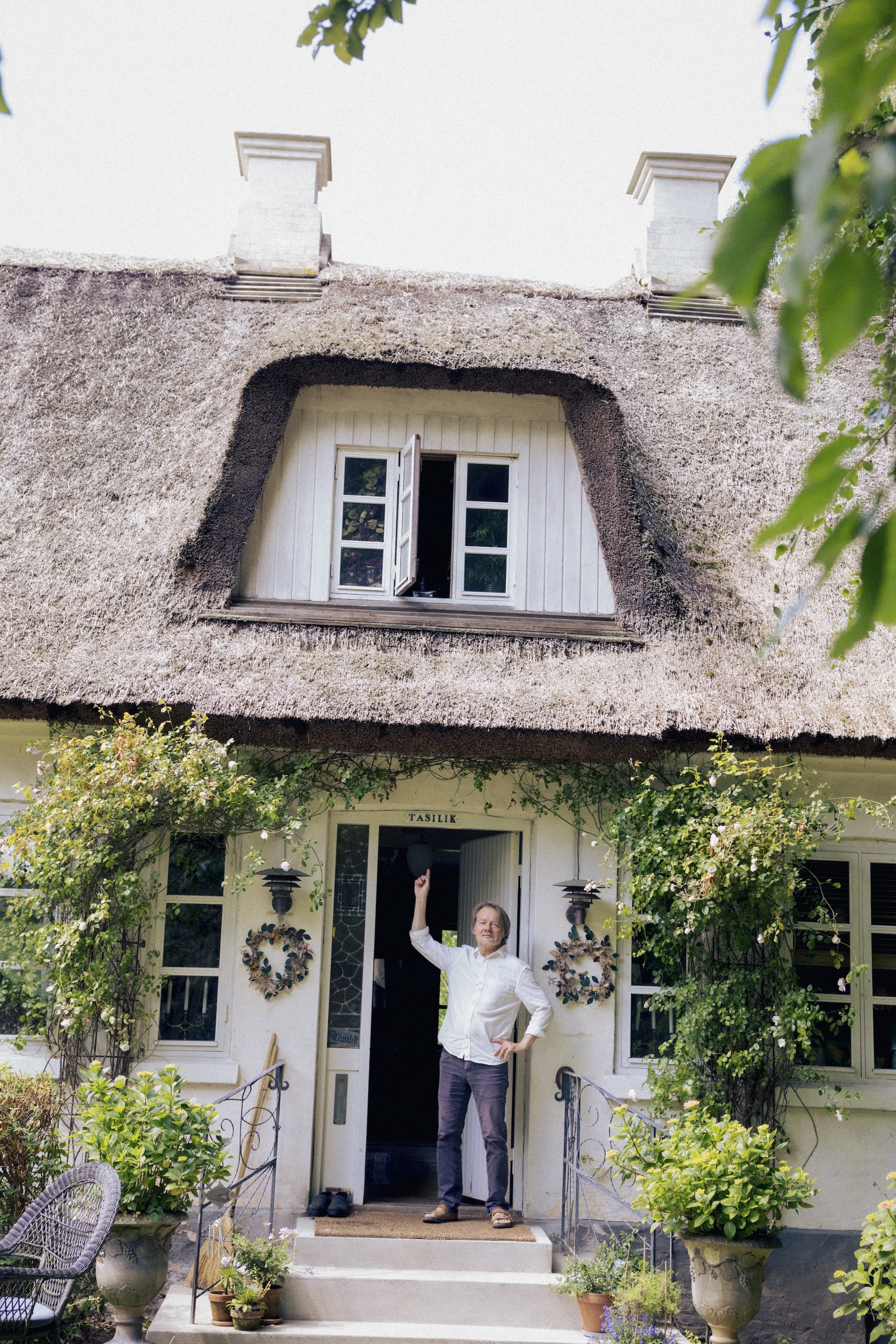
Built in 1826 as a village school, it later became a summer residence of the governor of Greenland. When they bought it, the seller showed them a photograph of a man in the courtyard. It was Knud Rasmussen, the Greenland-born polar explorer and something close to a Danish national hero, who once travelled sixteen months by dog sled across Arctic North America. One day he kayaked across the fjord from his home in Hundested to visit a friend who lived here, a linguist working on the Danish Greenland dictionary, and gave the house its name, Tasilik, Greenlandic for “by the lake.”
“Everybody who lives in this house will get in contact with Greenland, if they haven’t already,” Peter says. He and Margrethe have since made the journey themselves. “There’s something magical about this place.” For a painter whose men have spent decades searching, there is something fitting about coming to rest in a house named by an explorer. Does he ever want to leave? “Noooo,” he says, before the question is finished. “I really love this place.”
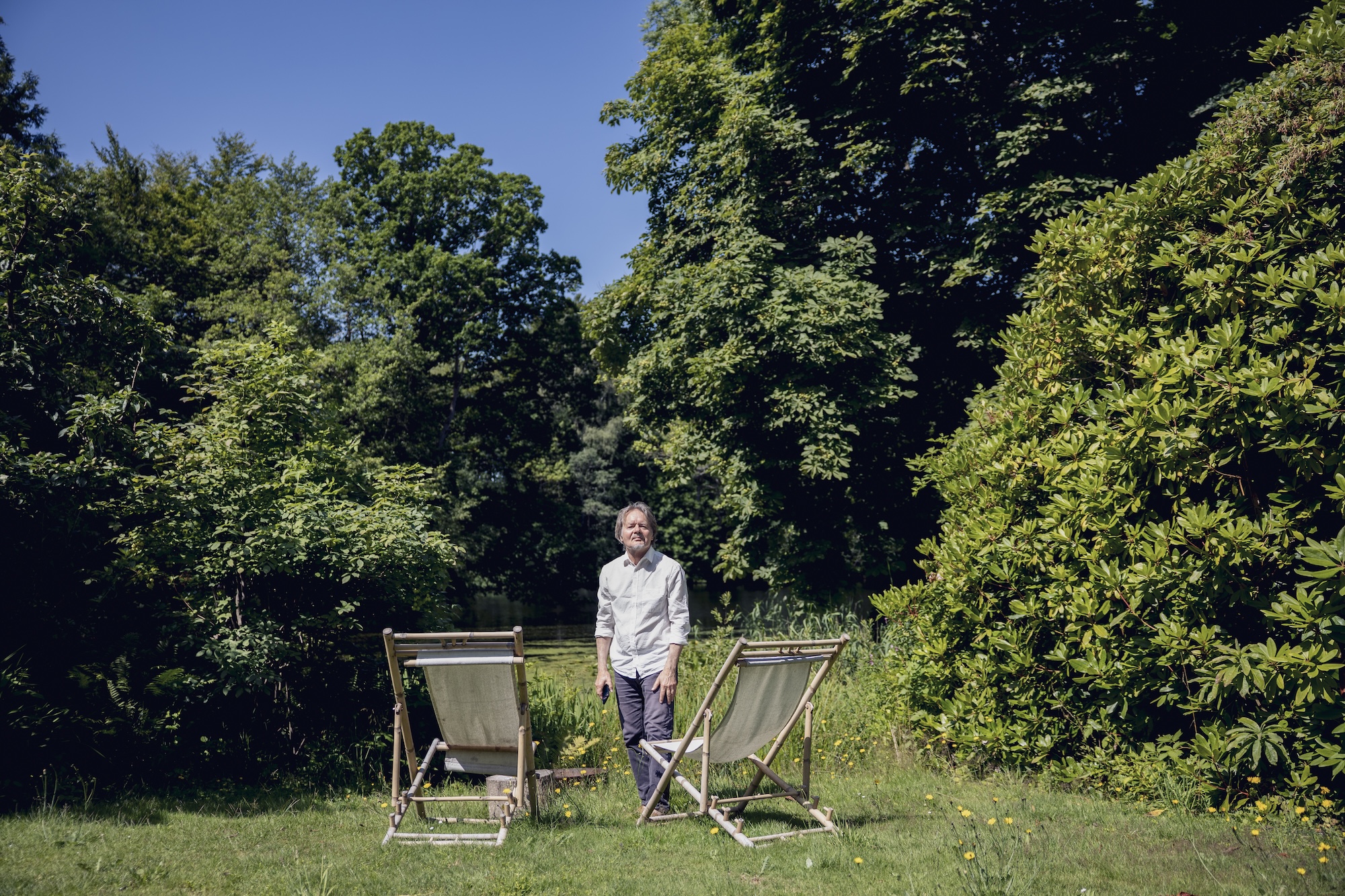
Around the house are 13,000 square metres of land, and Peter watches all of it. At night, cameras strapped to the trees record whatever passes. By day, he follows the snails. “I give them names and dates so I can follow them… I used to put my friends’ names on them, so it can be very scary when one of them dies… I am thinking, where is Morten?!” Even the shed keeps watch. On two tiny windows in its doors, he has painted his own face and Margrethe’s, looking out. They catch me completely off guard, as I suspect they are meant to catch any uninvited visitor. His mother, with her horror stories, would surely have approved. “Even when you’re not here, you’re here,” I tell him. He laughs, as if that were exactly the point.
Lately he has begun keeping diaries from the garden, two hours at a time, and this year the Odsherreds Kunstmuseum has gathered the work of these years as Diary from Tasilik, open until October 18, 2026. How has this place changed him? He lays his hand flat on his chest. “It’s changed everything in here. A lot of my work is on nature too… These men in white shirts, they also go out in nature.”
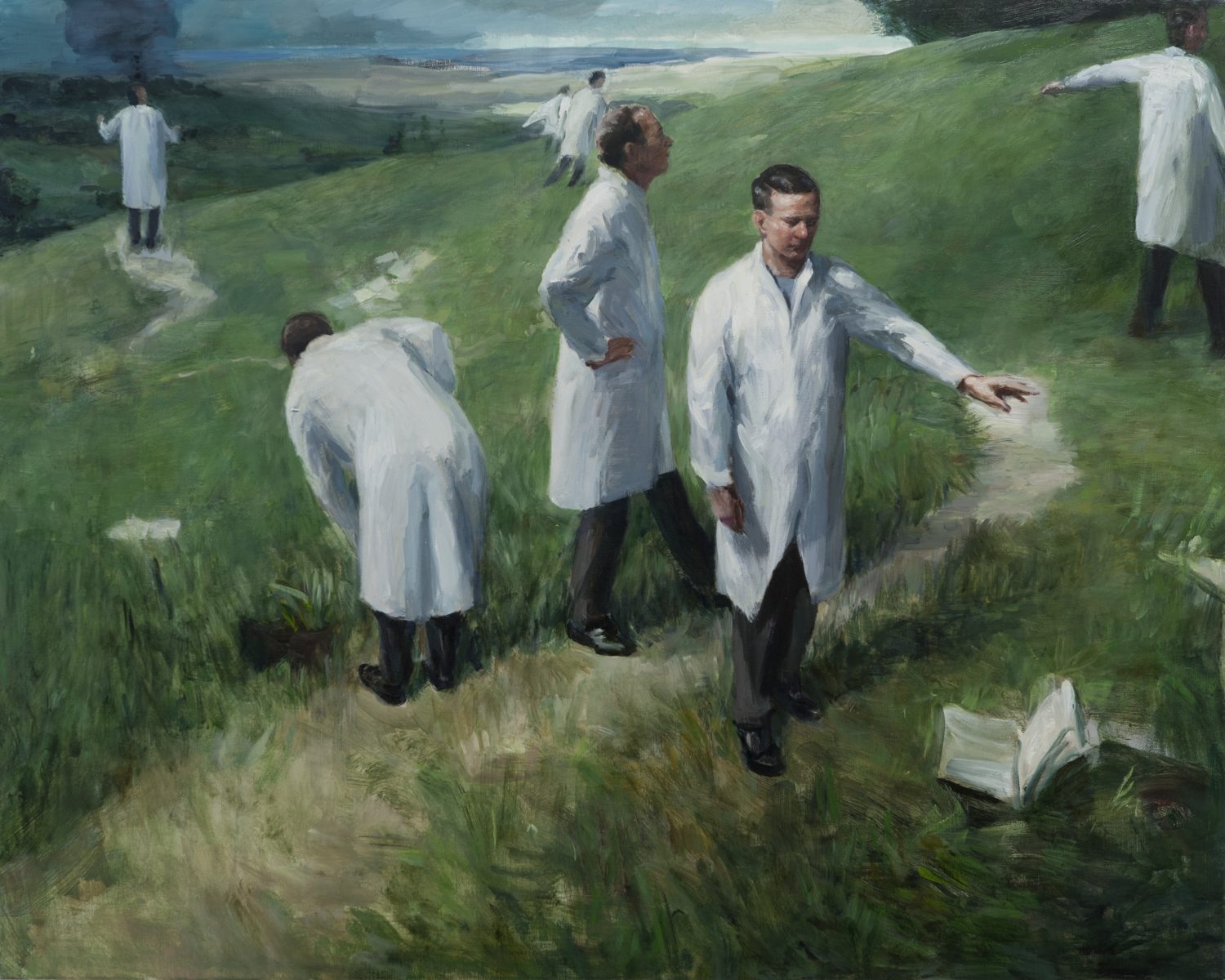
In The Weathermen (2022), his men have left the museum for open land. More than a dozen white coats hammer stakes, raise poles and chase papers across the ground as a storm gathers overhead. One man, in a jumper rather than a coat, stands apart, watching. It is tempting to see Peter in him. By the lake, he sometimes paints for hours, chasing the changing colour of the water. “But I never seem to get the exact moment I want, because it changes so quickly.”
Here, among things that need nothing from him, he has found a kind of peace. In a place as extraordinary as Tasilik, he remains an ordinary man, and glad of it, like the men he once described to me, a democratic man, a free-thinking man. Even so, he cannot fully trust what he sees. A painting that seemed perfect at night looks all wrong in the morning. “I cannot trust my eyes. They cheat me all the time.” On a better day, it may change again. “When I am lucky, when things work well, then I can see the potential.”
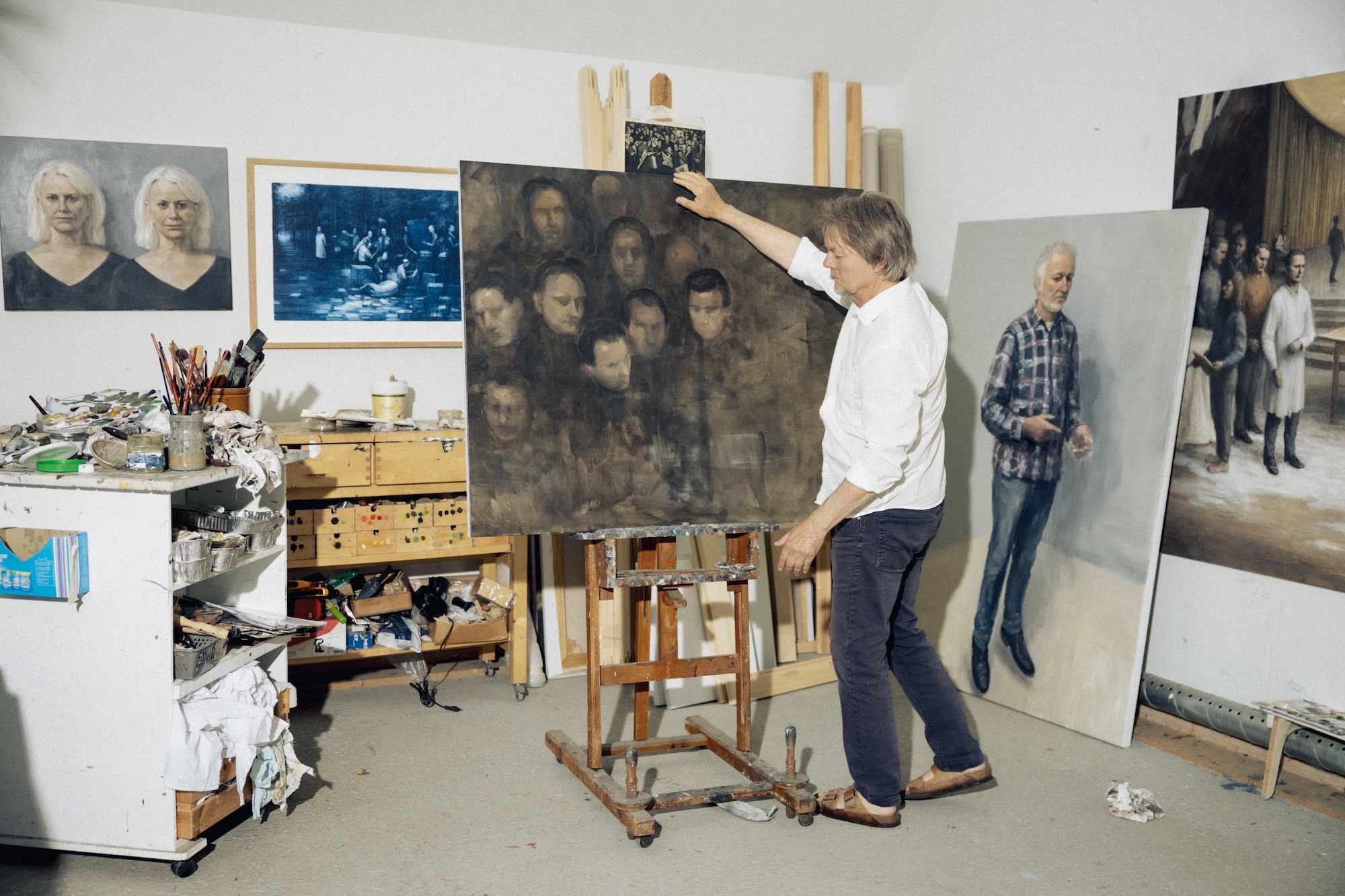
If a painting can be seen anew, so, perhaps, can a man. The harder question is who is looking, and how long they are willing to wait.
“I have hope for humanity,” he says, then corrects himself. “Well, I used to be optimistic.” When did the optimism die? He closes his eyes and half smiles. “It seems today, the idea of being optimistic is totally insane, because there’s only disasters all around.” The news reaches him physically, he says, and afterwards he struggles to settle back into his work. Of his own life, he doesn’t hesitate. “Lucky, I feel lucky.” Luck, after all, is not something a man earns.
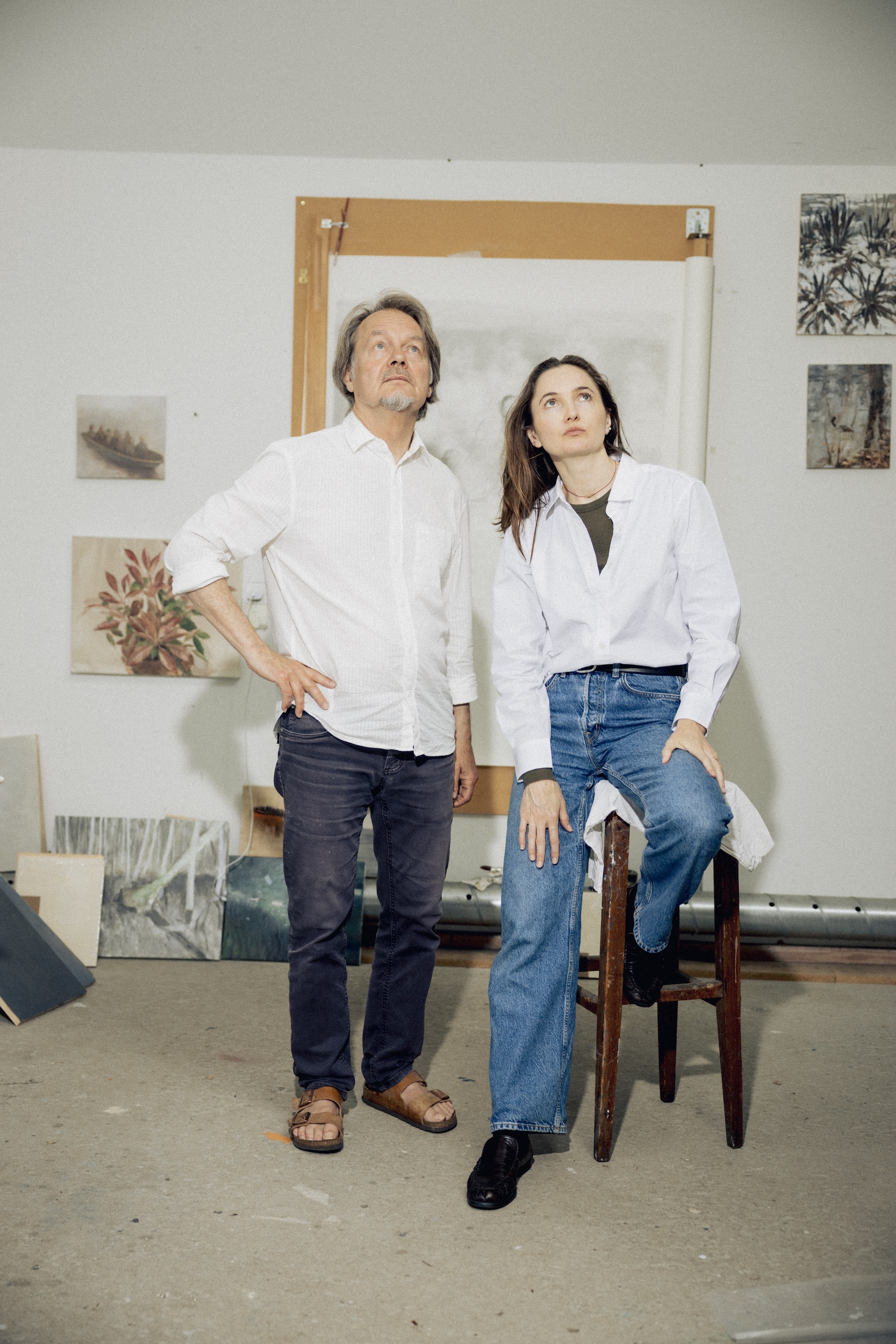
For our final photograph, I ask if we should sit. “I am not an old man,” he says, smiling, and stays on his feet. “I don’t feel any different, except in my memory.” I take the stool beside him. Peter looks up, and I follow. “It’s a mystery!” he says. Click. And again, “It’s a mystery…” Click. He doesn’t say what. Growing older without feeling it, eyes that cheat him by morning, a love that has endured, the men he has painted for fifty years. Perhaps he means all of it.