A conversation with MARY FRANK

On time, nature, and transformation — how art becomes a practice of care.
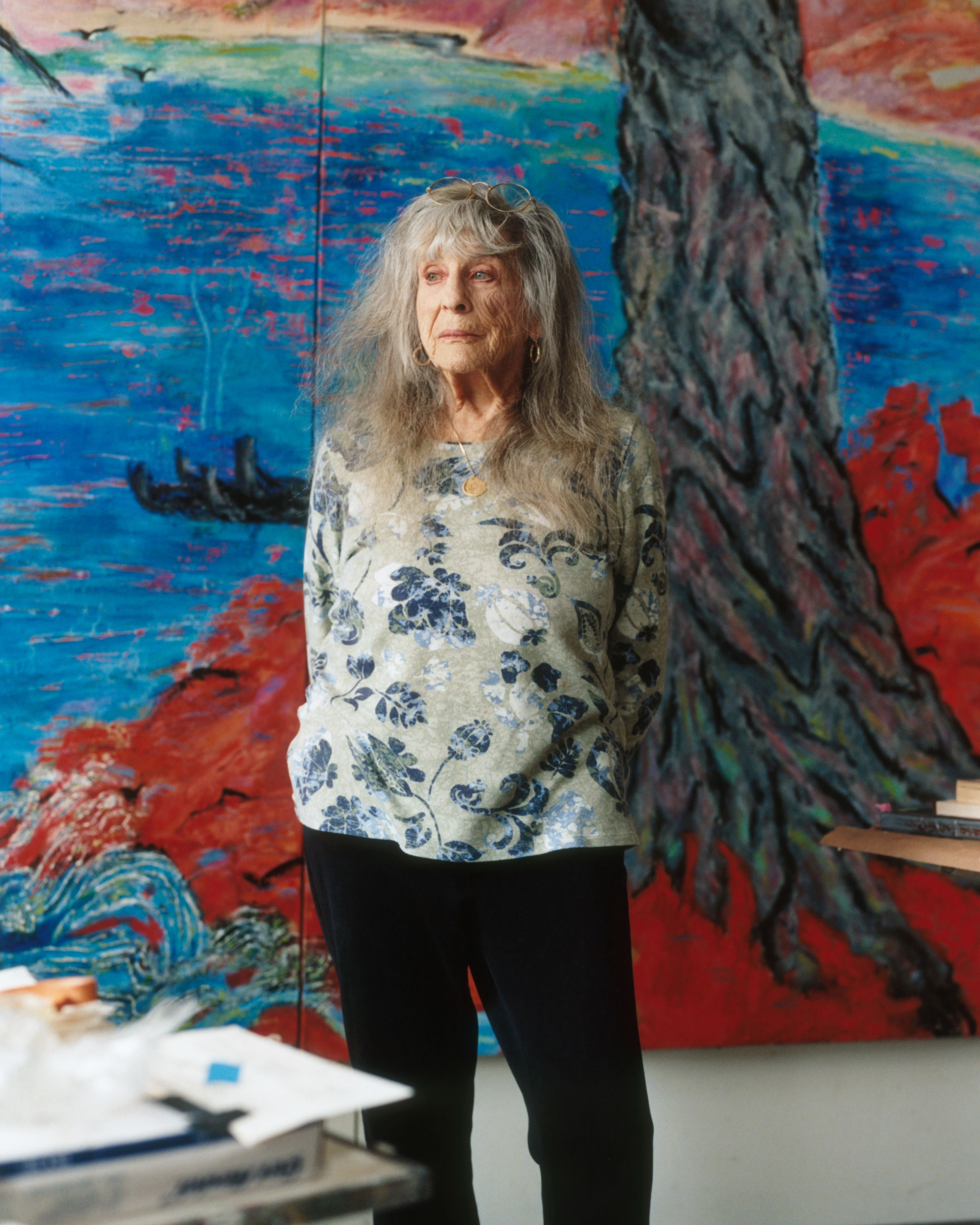
“The thing about time now, it feels so other… sometimes I am waiting for the day to end… sometimes I am waiting for the night to end… so what am I waiting for? I can’t say.”
At 93, Mary Frank has spent a lifetime making work that reaches toward a world we are still failing to inhabit, and is a stark reminder of how far away we are from her dreamlike reality. Whatever the medium — painting, drawing, sculpture, protest poster — the questions underneath are always the same: what would it take to live in harmony with each other, and the natural world? How much more pain do we need to go through to reach peace?
“What is art for?” Mary Frank recently posed at an April 2026 talk at The School of Visual Arts in New York. She swiftly answered her own question. “To comfort the dead, to wake up the living, to mark the change from day to night, to use oneself fully, to know that we are nature. To know the migrations of stars, plants, birds, fish, mammals, and the immigrations of people. To give courage and to transform the experience of pain, into whatever it can be transformed into, sometimes joy. And to take nothing for granted.”
Mary Frank’s first lessons in art were guided by German expressionist Max Beckmann and German-American abstract expressionist Hans Hoffman. However she was most influenced by artist Jan Müller, a fellow student. Originally starting with sculpture as her dominant medium, Frank moved primarily to painting later in life. Across all forms, her work remains anchored in the same elemental forces: earth, oceans, rivers, plants, animals, and the cosmos, each a reminder of where we began. When human figures appear, they are rarely at rest. They reach, grip, leap, and press themselves against the living world, as though they can feel it slipping away. At times, this urgency gives way to something more otherworldly, a kind of disbelief at how far we have already drifted.
And yet, Frank does not end in despair. Layers of mixed media — paper, clay, textured surfaces — build a sense of excavation within the canvas. Colour becomes a signal to dig deeper, to uncover new light. What emerges is not closure, but possibility, and that a new beginning, even a kind of revolution may be closer than we think.
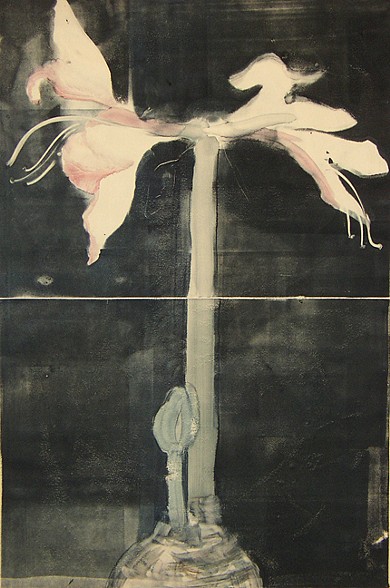
“I am still learning,” Mary says in response to her relationship to color. “It’s very important, and I think it’s a huge mystery. It feels to me like the biggest mystery in working.”
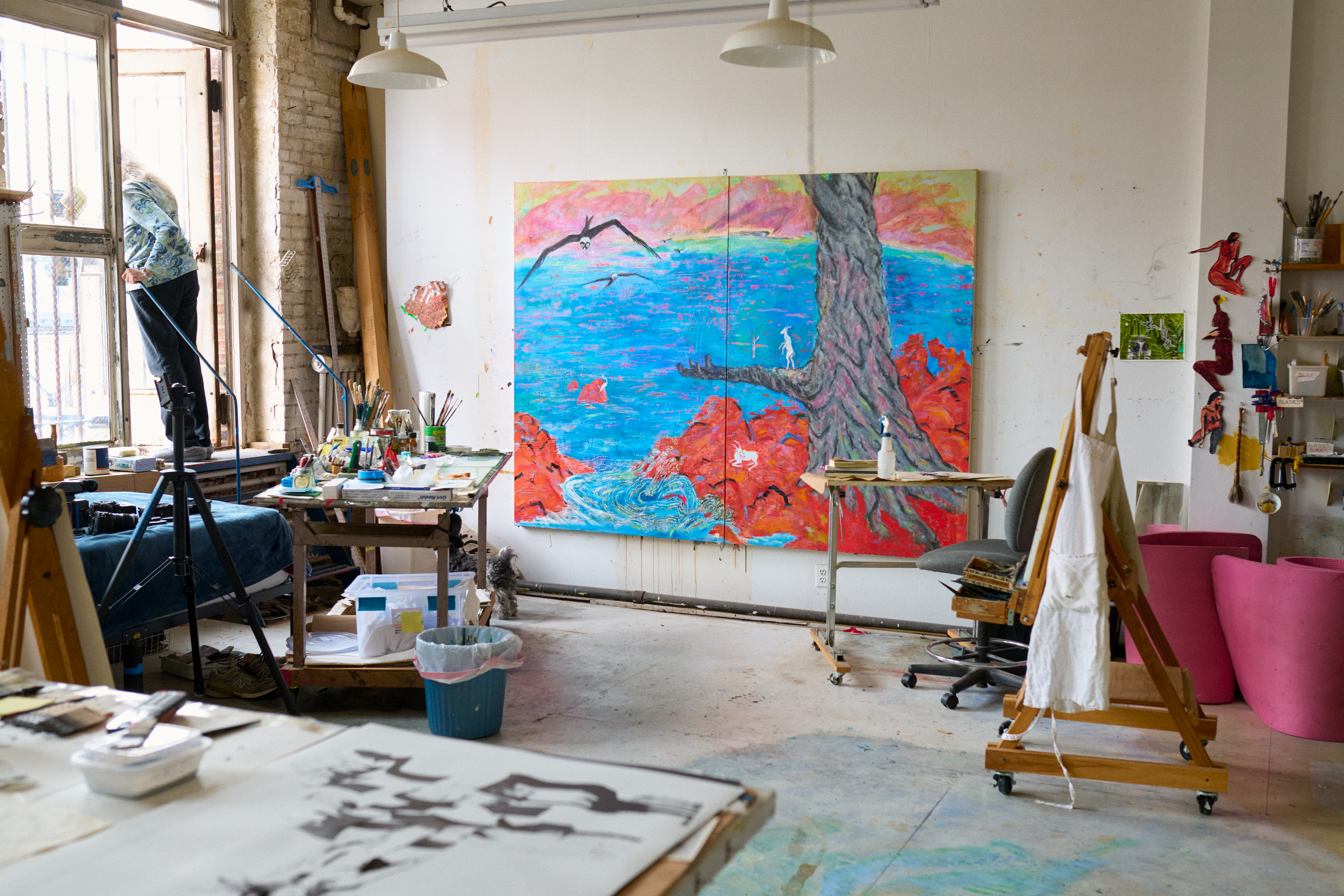
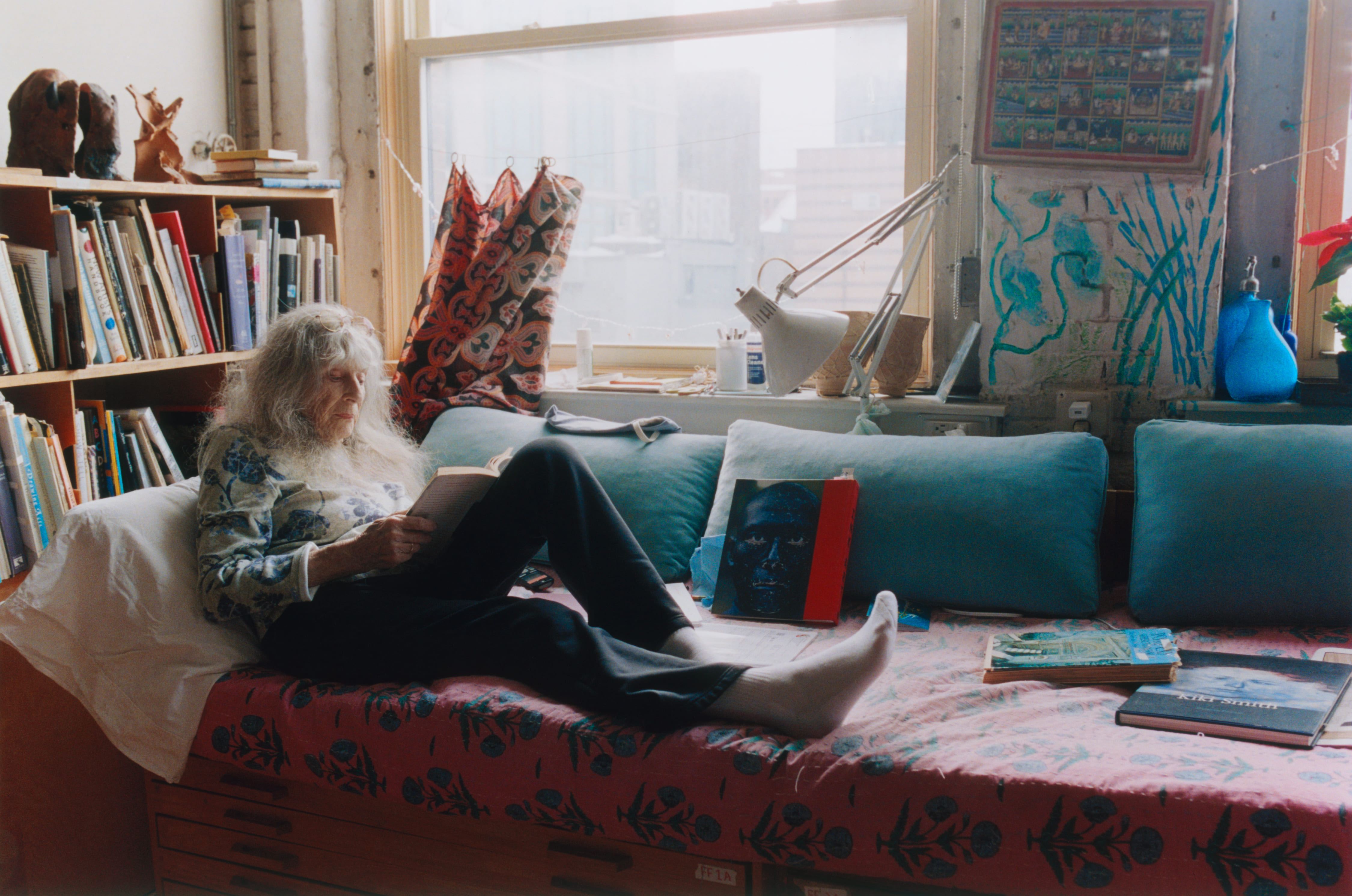
I’m speaking to Mary Frank in her Chelsea loft, at the back of her studio where she now sleeps on a single bed. She’s laying down at a 45 degree angle, propped up by just her forearms ready to speak to me. She’s made herself very relaxed, and with a “You sit here” gesture, pointing at a nearby chair, I too immediately feel at ease, sitting so close to her bedside my knees are knocking up against her mattress. Her feet — adorned with light pink socks and a frill around the top — are dangling off the bed, shoeless, pointing back and forth as she talks. “I always wanted to be a dancer,” she shares, while looking at her feet, so softly as if in secret, reminding both her feet, and herself of her origin story, a time when she moved more freely.
“I barely go out anymore” Mary begins. “I had a fall recently, before that I was walking quite a lot, but I don’t go around the city like I once did… It's also very different now, and so many little stores are gone, and those little stores were what made it… all these big stores on every corner, owned by oil companies, it's terrible.” She’s looking out the window behind her bed as she finishes. “I feed the birds” Mary adds, as if speaking to an alternative act of outside activity. “Morning doves, sparrows…” she trails off.
When I first saw Mary Frank speak at DC Moore Gallery on December 6, 2025 to open her show “As If for the First Time”, it wasn’t so much how she spoke, but what she chose to confront. There was no interest in the surface, only an immediate pull toward the underlying weight and pain of things. Her voice, soft and at times fragile, seemed almost at odds with the gravity of her words, revealing a sensitivity attuned to depth, and to the emotional cost that often comes with it.
“I have been told by a therapist that I am super sensitive to many, many things, things that other people may also not like, and could be unhappy about, but they wouldn’t respond so strongly.”
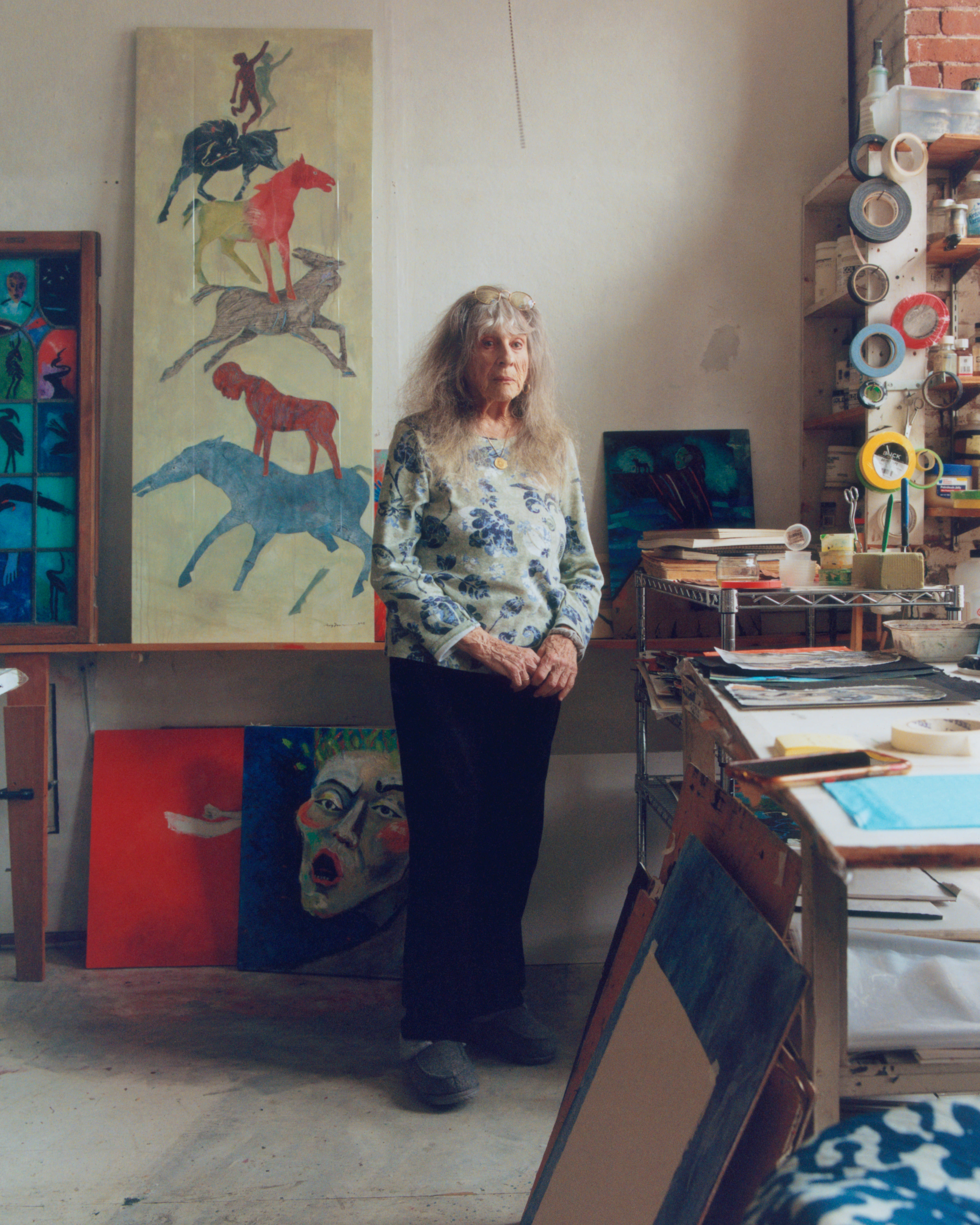
Mary Frank first came to New York as a child with her mother, traveling from London during the Nazi bombings in the 1940s. Her father couldn’t join them as men couldn’t leave England during the war. “...And it wasn’t like now, where you can pick up the phone and talk to people around the world.” Mary shares. “My father wrote letters, but they always came censored. There were women in England whose job was to cut out pieces from millions of letters. My father had nothing to say that could have been of any use to the Nazis or anyone else, I don’t think. He was a musicologist. I didn’t really know him, and later had a very difficult relationship with him… and then none, mainly none.”
At first Mary lived in Brooklyn for five years with her grandparents, Russian refugees from the 1870s, “...They too had fled because of anti-semitism. After that, my mother and I moved to a tiny place in the East Village where I slept on top of an upright piano. There was no room for an upright piano and a bed in that room, so the piano took precedence. I was around 12 or 13 at the time.”
Mary Frank didn’t so much enter the art world as was born into it, and early on saw how it could eclipse someone’s attention. Her mother, Eleanore Lockspeiser, was also an artist. “But I never wanted to do what she did,” Mary says, shaking her head.
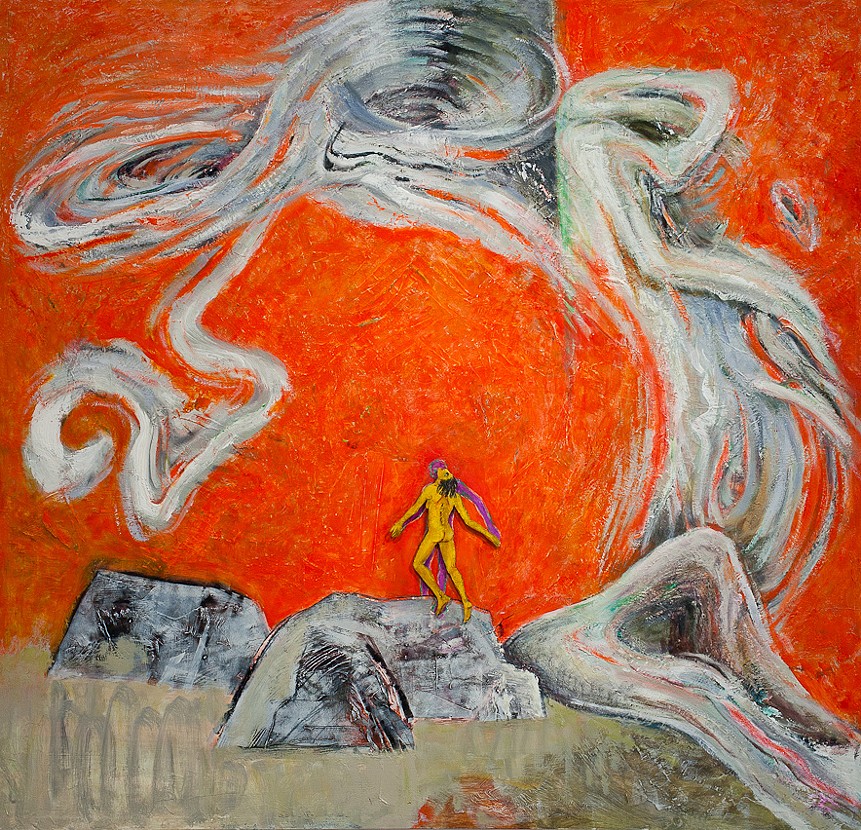
As a child, art always came before her. It symbolized something bigger than Mary, bigger than being a daughter, bigger than the love of a parent, of motherhood.
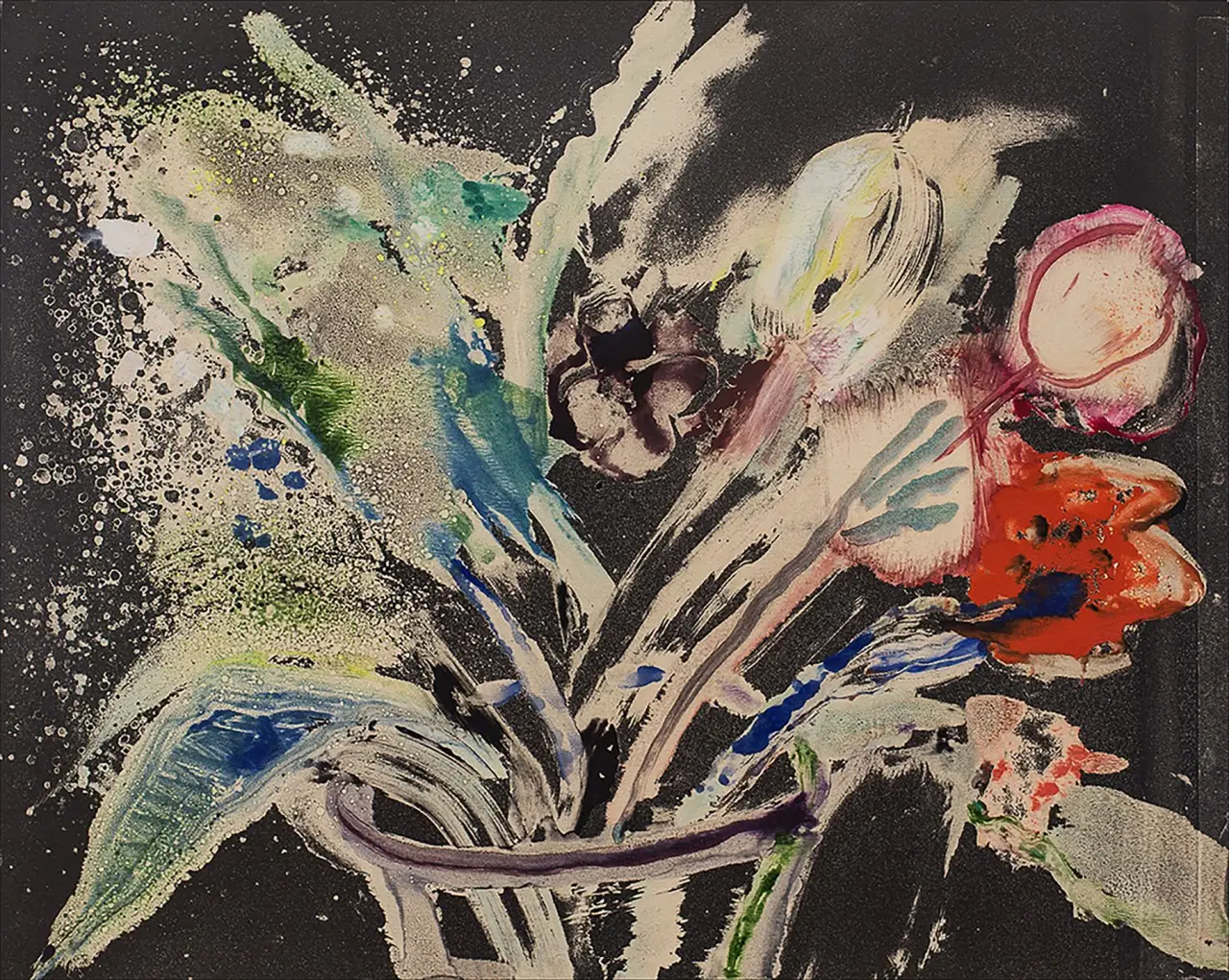
“I have many memories of talking with my mother when I lived at home,” Mary says. “I’d be speaking to her, and she’d be looking at her work. When she did reply, her eyes and her words were rarely directed at me; they stayed on the art, even while we were talking. I didn’t like that.” She pauses. “So, yes… it took me a while to enter that world as it was the place that excluded me, one that my mother seemed to prefer more than time with me…”
Before painting, dance offered a more collective and expansive form of expression, and it was where Mary Frank’s early interest lay. “I studied with Martha Graham and then José Limón, as well as Indian and Afro-Cuban dance. I don’t think I would have become a professional dancer, I was more drawn to choreography,” she reflects. “But studying with Martha Graham was an extraordinary experience. She had a profound influence on me, no question.”
Mary returns to her mother. “She talked about art, and later quite a bit about politics, but not really about life, or living. I think she simply wasn’t able to. She was born in the 1900s, maybe it was generational. She lived until she was 88.” And yet, “Even with the memory of those feelings” she adds, “When I became a mother, I found myself doing the same with my own children, probably even more so."
When I ask Mary when that distance between herself and her mother’s practice began to close, when art entered as a possibility, she gently corrects the premise. “I would have loved to continue dancing… but it was more that I was pregnant at seventeen with my son, Pablo. I had just turned eighteen when he was born. This, of course, was not planned,” she adds. “And at the time, we had no money… Robert became very famous only later.”
“It was a beehive of all kinds of artists,” Mary says in John Cohen’s film Visions of Mary Frank, recalling the East 10th Street galleries just around the corner from where she and Robert lived. It was an incredibly formative downtown period, when, at a young age, they found themselves among figures like Philip Guston, Willem de Kooning, Richard Rauschenberg, and Milton Resnik. At the same time, the Beat Generation was in full swing, and Allen Ginsberg stood out to her as “the best.” “He had the ability to speak in very good ways,” she says. “He could talk to a cop, or a drunk, or me, or you — he just had this gift, like a very good Rabbi.”
“It was very lively,” she continues, “with a feeling of improvisation about everything.” The boundaries between a party, an opening, a happening, or simply people gathering were blurred. With stoops everywhere, it was easy to stop, talk, and argue about art. “Most galleries now don’t have stoops at all,” she notes, “and the arguments about art go on, but in a different form.”
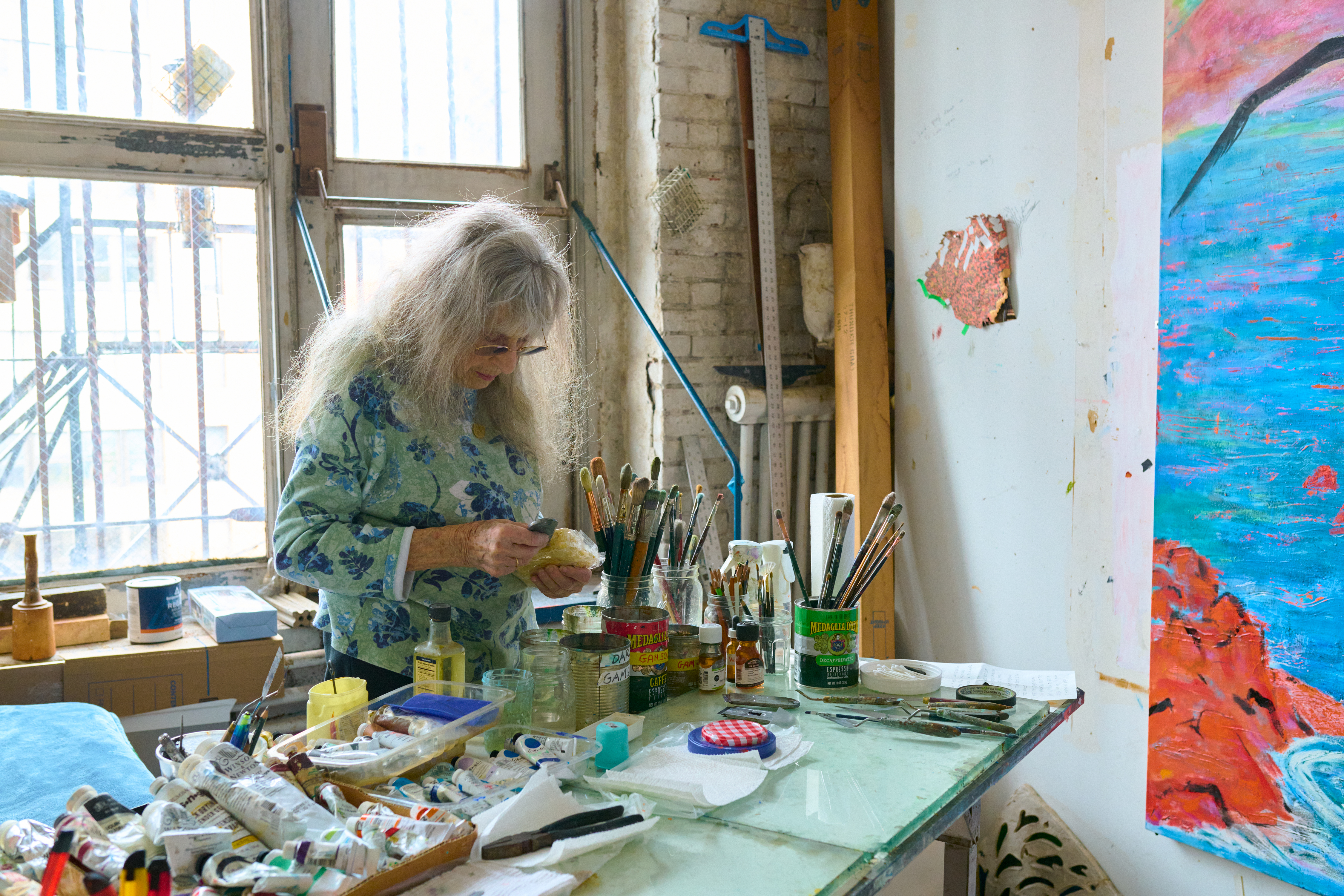
Growing up as an only child never affected Mary, it was only when she met her first husband Robert Frank that she realised how much this great love meant to her. How much she needed this engulfment of recognition.
“It just happened, but it was very important to me,” Mary says of this relationship. “He was nine years older, which might not seem like a big deal when you’re older, but at sixteen, it was huge. It’s not that he was particularly mature, but he had already traveled… to Peru, to Paris, seen a lot, done a lot… gone to prostitutes, all that stuff.” She laughs. “He’d lived quite a bit, and if I hadn’t gotten pregnant, who knows, maybe nothing would have happened. I don’t think he was eager to start a family. Very little was planned in my life for a long time.”
The draw to having a traditional family never interested Robert or Mary, it wasn’t something they were ever searching for. “I had nothing to do with children. I’d never babysat, maybe once. I had no siblings, no experience with babies, zero. I really knew nothing, and Robert didn’t either. Of course, it was worse as a woman then that I didn’t and I wasn’t open to listening, either. My mother did help, but she was critical, not in a mean way, but in a real way, about the things I did that were stupid or unhelpful.”
Even today, there remains an unspoken expectation that women prioritize partners and children over themselves - an expectation that continues to shape how their independence is perceived. Despite these pressures, Mary acknowledges Robert’s support.
“He was much more supportive of me as an artist than as a mother, but he also traveled a lot, often for work, but typically remained beyond the project, staying for weeks in Europe, sending letters. Did I manage it all? Well, with a lot of difficulty…we also had a lot of affairs, both of us.”
“Out of necessity, to feel alive,” I ask, “Yes, I think so… He was a very depressed person, very angry and difficult — but a terrific photographer.”
Mary married her second husband, the musicologist Leo Treitler — like her father — in 1985. The Chelsea loft is where they live to this day, 41 years later, Leo now aged 95.
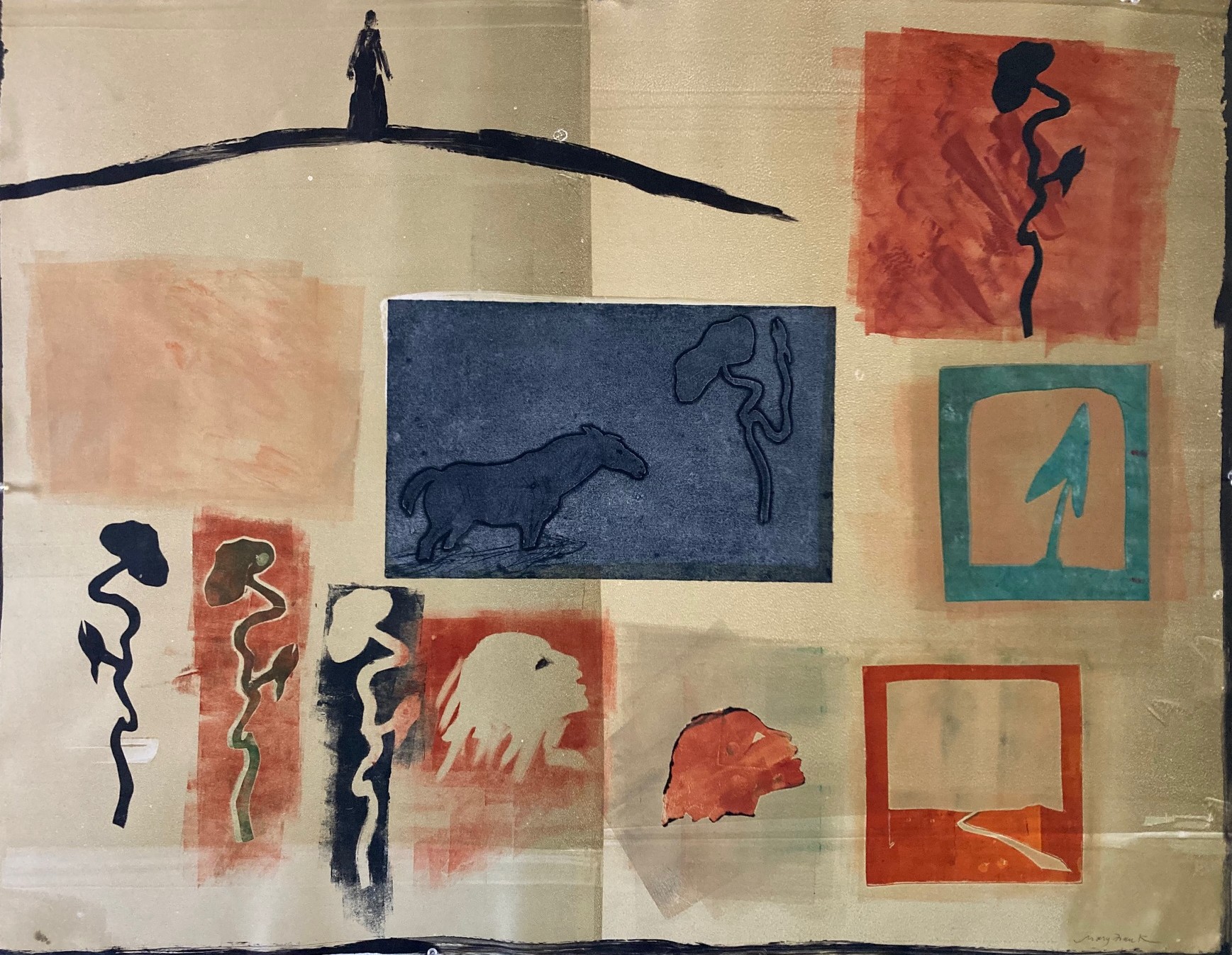
“What am I waiting for… I can’t say” is a sentiment of Mary’s I can’t shake. I landed on her piece, “Witness” from 2021. A face, almost as if from the heavens peers down from the top left-hand corner of the painting overlooking an ocean where a single being, swims, face up, in what looks to be fresh water, but pooling up from the bottom of the painting is an oil like substance, as if there has a been a spill of pollution that the swimmer is trying to avoid. That darkness is always near.
Mary speaks of being an only child, something she says she did not think much about when she was young, but feels more sharply with age. She has “many people around,” and yet the absence defines itself differently now. “My two children both died, and I don’t have grandchildren.” Her son, Pablo, had cancer but died by suicide in 1994; her daughter, Andrea, was killed in a plane accident in Guatemala in 1974.
“I am very struck by it,” she says, returning to the idea of generations — of families extending outward through cousins, aunts, grandchildren, great-grandchildren. “The difference between Pablo and Andrea… Andrea wanted to live, and her life was taken. Pablo didn’t want to live, and chose to leave."
Pablo and Andrea are hidden within many of Frank’s paintings, some explicitly, some abstract, and others only she can see. “It’s a pain that never leaves you” she describes, so bringing her internal images in some way to the outside can release this pool of emotion. “I do think of them a lot of course, yes… and I have quite a lot of babies through my work… hundreds, many of them within the collages... I will probably always have regrets with how I was with the children…” Mary finishes.
Although art did not initially represent the possibilities of connection — both to herself and to the world around her, it is now the source of her day-to-day purpose.
“I can’t imagine living without it. I can’t imagine not working. Every day I get up, and I work.”
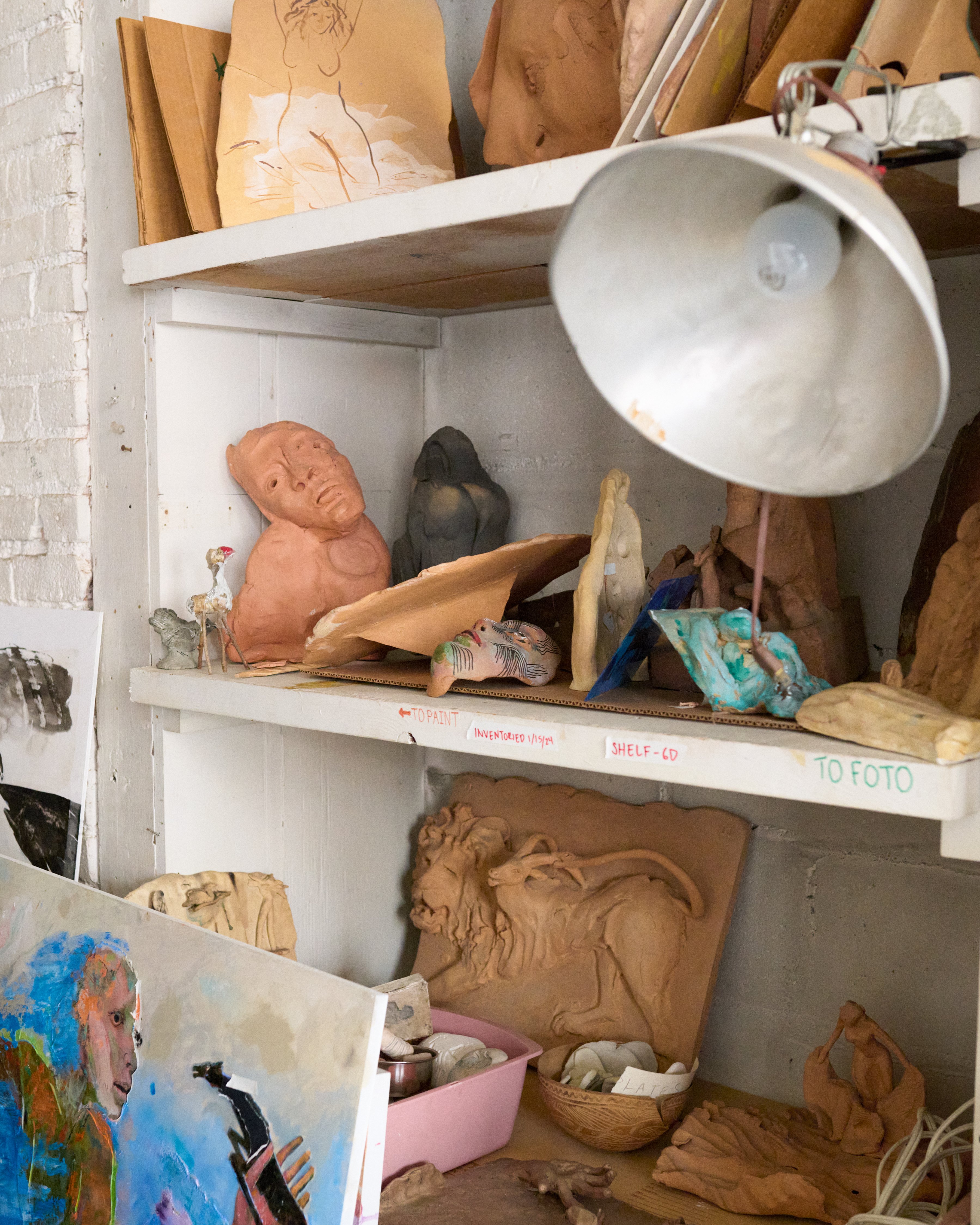
Needless to say, not every day is easy, yet Mary Frank has never been defined by her life’s tragedies. Her tenacity to keep going and live through these moments is how, as American Art Historian Linda Nochlin states, “Her pieces make you work… I think you need to work through some of the material, almost as if when you work through things in an analysis, or work through experience… to arrive at a different formulation of it.” All of these stories are layered within, her human characters showing up as temporary visitors on this earth. An existential reality that Mary Frank is never fearful of looking at head on.
“There’s no other way, or option than to keep going.” Mary responds. “But I am sickened and horrified by the world as it is now, and the decimation of innocent people, babies, insects, fish, every mammal, birds, everything alive, plants, everything, all of it, under siege. Climate and greed and population, and to talk about climate and not talk about population is nuts. Hardly anyone talks about population.”
Looking again, there is a maternal undercurrent running through much of Frank’s work, a sustained attentiveness to care, protection, and the fragility of life. This extends beyond the studio. She has long been involved in political and environmental activism, including participation in anti-war protests and broader peace movements of the late twentieth century. Alongside this, she has been a committed supporter of Solar Cookers International, promoting simple solar cooking technologies through lectures and demonstrations as tools for ecological sustainability, public health, and women’s autonomy in regions affected by resource scarcity and conflict. In this way, her activism links art, survival, and environmental ethics in practical and deeply human terms. Around the world, ~45 million people use solar cookers.
“Protest is essential” Mary comes in. “Essential. I have always been a part of protest as a means to create movement, even before the Vietnam war. I made posters and marched in many of these protests. The Iraq war… I made posters for these too. More recently the ‘Don’t Tear Families Apart’ posters to fight against ICE.”
This impulse to act outside of making objects is part of the same practice, a way of staying engaged with a world in crisis. It is an ethical orientation toward responsibility at a collective scale, toward what it means to “show up” for life beyond the personal.
There’s a line in Anaïs Nin book, A Woman Speaks that makes me think of Mary, “We have to believe that there is a transcendental truth, that our life is not composed of simply a crisis or a trauma or a terrible moment which makes us feel that we might have to disappear or drop out or forget everything. We have to believe that there is a continuity, that life has a continuance.”
Mary speaks of her large circle of “great friends,” which she calls “her tribe.” The term, she explains, is less expansive than it sounds. It refers in part to those who have helped her in the studio and spent years archiving her work. “Whether all that archiving will go anywhere, who knows,” she says. “It’s difficult to say now.” She reflects on what it means to place work in institutions — museums, universities, archives — and the shifting conditions around legacy. She has work in major collections, but notes that the landscape has changed. “There are millions more artists now, and the storage is filled up. If you’re a superstar they’re very interested in your work, the ones who sell for staggering amounts of money, who show in Europe, that’s not me.”
It is at this point that I insist on the word, “Superstar,” not as flattery, but as a refusal of its market definition. In a system that equates superstardom with sales, visibility, and speculative value, I argue instead for another measure: a life of sustained work, discipline, and continuity. Mary Frank wakes each morning with everything she has lost and still returns to the studio. She does not stop. If superstardom is usually defined by money, then it feels hollow — built as much on luck and timing as anything else. Recognition, in that sense, often arrives too late to be of use. And yet by any institutional measure, Frank’s position is already secure: her work is held in major collections including the Museum of Modern Art, the Whitney Museum of American Art, and the Metropolitan Museum of Art, also receiving two Guggenheim Fellowships alongside support from the National Endowment for the Arts. Over a long career, she has also had numerous solo exhibitions across the United States and internationally, sustained across decades rather than defined by a single peak. “What is this if not superstardom??"
At this question and the end of my monologue on superstar-status, Mary remains, lying at ease on her bed listening, the same position as before, pointing her feet back and forth. I think she gets my point. I tell her she looks light. “I don’t feel that way at all. Certainly not light. I have moments when I do…”
Everything from when you’re very young impacts you… and as they say, you can only do what you can with the tools that you have at the time, but hindsight, as they also say, is a bitch, and regret is inevitable. “You can’t use it now” Mary responds, in relation to wisdom. “The wisdom we get with experience and hindsight, we can’t use it now, we can hold it, but we can’t change our past with the knowledge we have now. We can use it with the people we have in our lives now, living, but not to change the past.”
For most of us, there is an understanding that we will not get out of this world alive. Now in her nineties, Mary Frank has lived long enough for this truth to be inseparable from experience. Over time, loss has accumulated — her parents and grandparents, her two children, many friends, her first husband Robert Frank, who died in 2019. It forms a continuous presence of absence. Robert Frank’s 1978 photograph Sick of Goodbyes comes to mind.
“I have had a rich life,” Mary emphasizes, “With music and travel with my husband, Leo, and his children.”
“I still feel life is worth living, but I certainly think about death alot… I can’t believe anyone my age wouldn’t… some people may be able to put it over there,” Mary points to a corner “but not me. So many of my close friends and artists have died. They are not here anymore.” I tell Mary the saying that if you end up at a certain age going to a lot of funerals, it means you have a good social life. She can’t stop laughing, “Please write that down and send it to me.”
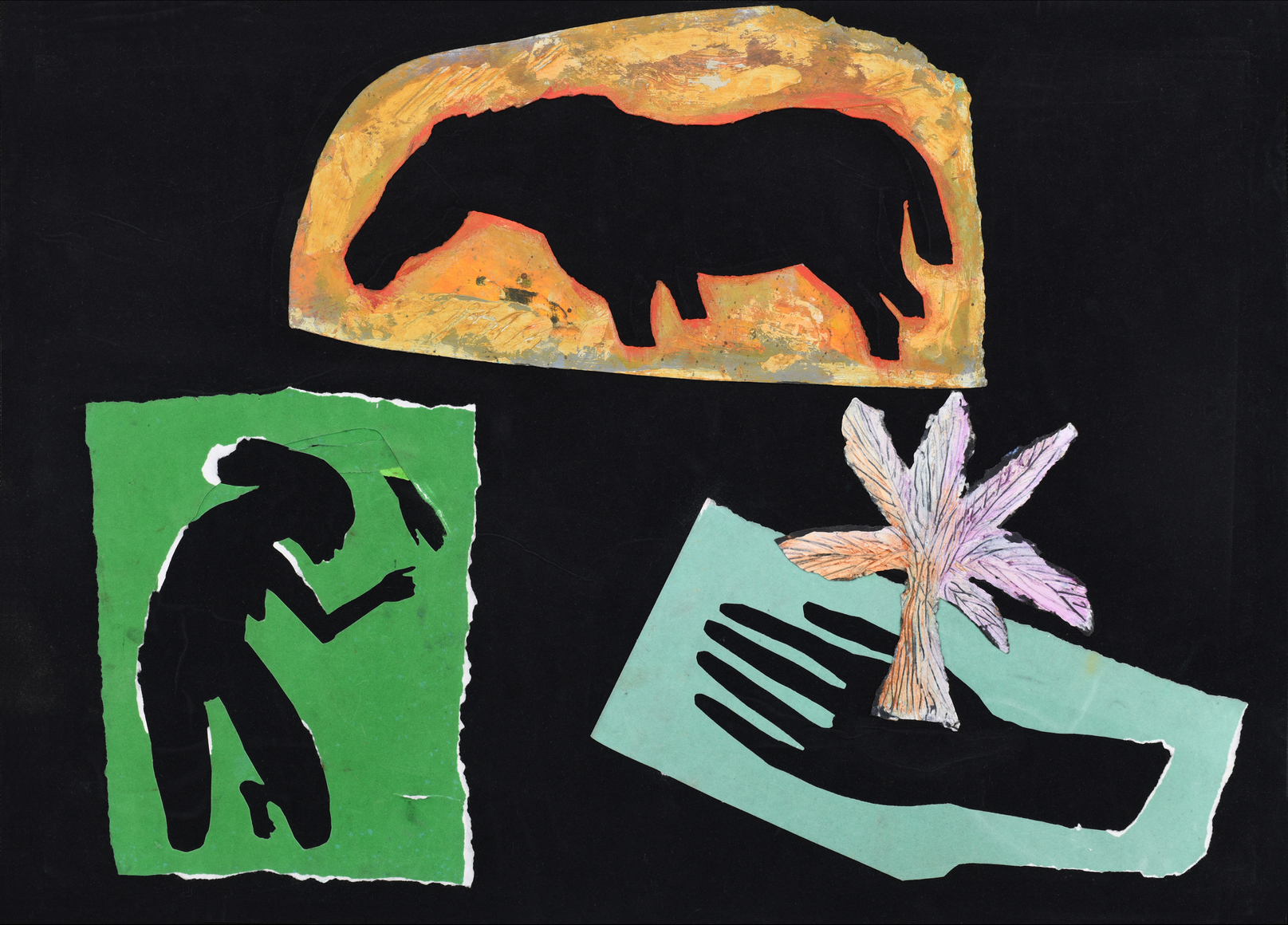
Mary Frank’s work is aspirational not in an optimistic sense, but in the older Latin "aspirare" — to breathe, to strive. Rather than displaying a naivety that everything will end well, its power lies in the insistence that, no matter how much has been lost, the continual act of pushing toward justice remains vital. What runs through her work like a clear stream is the understanding that a spirit, left unnurtured, will drown.
Mary Frank is represented by DC Moore Gallery and Steven Harvey Fine Art Projects in NY and Elena Zang Gallery in Woodstock NY
